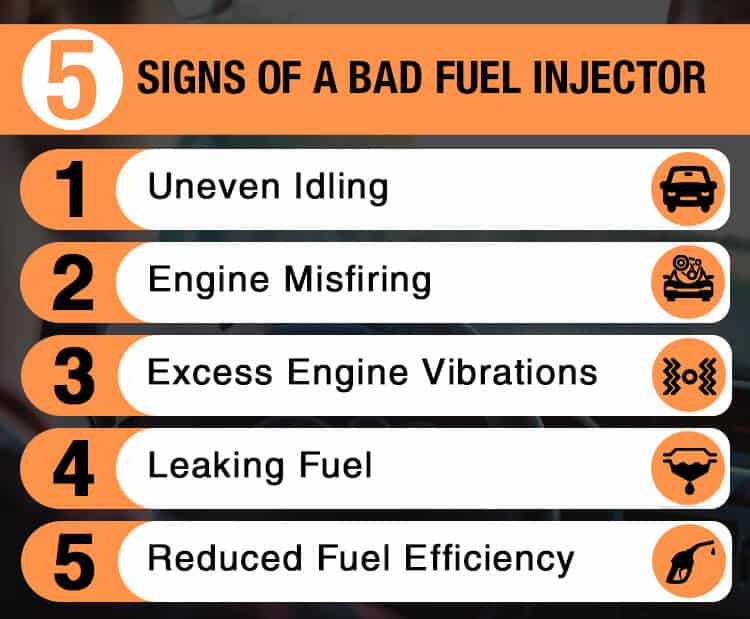
Fuel injectors deliver the right amount of fuel into an engine at the right time so it can mix with air and burn efficiently. They are a key part of a modern vehicle’s fuel system, and their operation directly affects starting, engine performance, fuel economy, emissions, and drivability.
So, what are fuel injectors and what do they do beyond simply spraying fuel? Each injector is a precisely controlled valve that opens and closes according to commands from the engine control unit (ECU). Depending on the engine design, it sprays fuel into the intake port or directly into the combustion chamber.
A problem with even one injector can affect how a cylinder runs. A restricted injector may cause a lean condition or misfire, while a leaking injector can deliver too much fuel and create an entirely different set of symptoms.
In this guide, I’ll break down fuel injectors from A to Z—from how they work and the different types used in gasoline and diesel engines to common failures, symptoms, testing methods, cleaning, replacement, fuel-injector sizing, maintenance, and the situations where professional diagnosis makes sense.
What Are Fuel Injectors and What Do They Do?
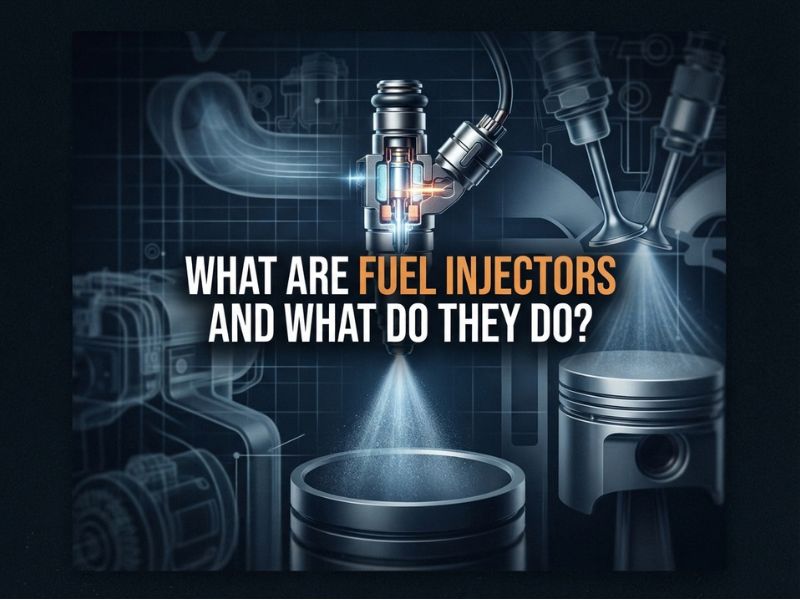
A fuel injector is an electronically controlled valve that delivers a precise amount of fuel to an engine. It opens and closes very quickly, allowing fuel to be sprayed in a controlled pattern rather than simply flowing into the engine.
In most modern vehicles, fuel injectors are controlled by the engine control unit (ECU) or powertrain control module (PCM). The computer determines how much fuel the engine needs based on information from various sensors and then controls how long each injector remains open.
The exact location of an injector depends on the type of fuel-injection system. In a port-injected gasoline engine, the injector typically sprays fuel into the intake port near the intake valve. In a direct-injection engine, the injector sprays fuel directly into the combustion chamber.
What Does a Fuel Injector Do?
The primary job of a fuel injector is to meter and deliver fuel accurately.
The injector receives pressurized fuel from the fuel rail or another part of the fuel system. When the ECU sends an electrical signal, the injector opens for a specific amount of time. Fuel passes through its small nozzle and is broken into a controlled spray.
The amount of fuel delivered depends on several factors, including:
- How long the injector stays open
- Fuel pressure
- Injector flow characteristics
- Engine operating conditions
- ECU commands
The ECU constantly adjusts fuel delivery as conditions change. An engine needs a different amount of fuel during a cold start than it does while cruising, accelerating, or operating under heavy load.
Why Are Fuel Injectors Important?
Fuel injectors are important because fuel delivery must be carefully controlled for proper combustion.
Too little fuel can create a lean condition, potentially causing hesitation, rough running, or misfires. Too much fuel can create a rich condition, which can reduce efficiency and increase emissions.
A properly functioning injector helps the engine:
- Start reliably
- Maintain a stable idle
- Respond smoothly to the accelerator
- Produce expected power
- Use fuel efficiently
- Control exhaust emissions
This is why an injector problem can sometimes look like an ignition, sensor, or general engine-performance problem.
How Do Fuel Injectors Work?
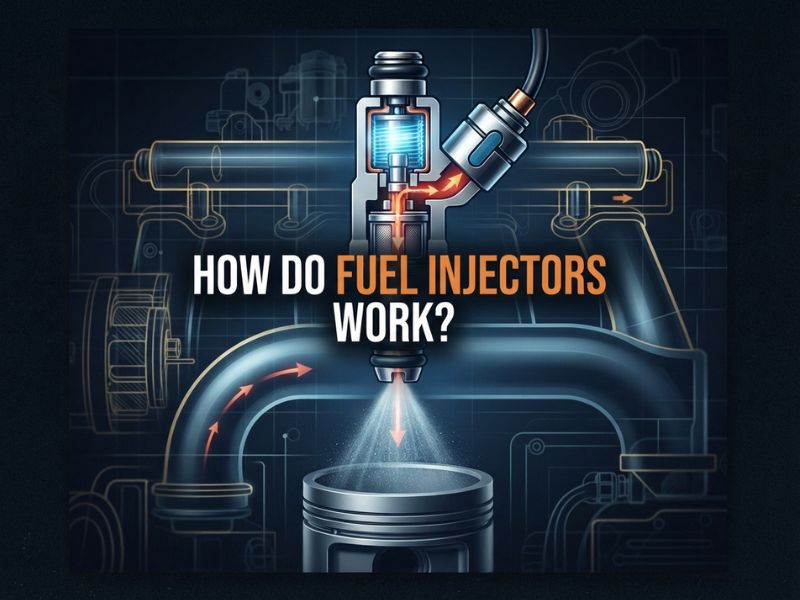
Fuel injectors work by combining pressurized fuel, an electrically controlled valve, and precise computer timing.
Although the internal design varies between injector types, the basic principle is similar: fuel is supplied under pressure, the ECU commands the injector to open, fuel passes through the nozzle, and the injector closes when the required amount has been delivered.
The Basic Fuel Injector Process
The process happens extremely quickly while the engine is running.
- Fuel is pressurized
The fuel pump supplies fuel to the fuel system, where it reaches the injector at the pressure specified for that particular system. - Fuel reaches the injector
Fuel enters the injector through its inlet and remains available for injection. - The ECU calculates fuel requirements
The engine computer uses information from sensors and operating conditions to determine how much fuel is needed. - The injector receives an electrical signal
The ECU energizes the injector’s internal electrical circuit. - The injector opens
An internal mechanism moves the injector valve away from its seat. - Fuel sprays through the nozzle
Pressurized fuel passes through the small injector orifice and forms a controlled spray. - The injector closes
When the electrical command ends, the valve closes and fuel flow stops.
This cycle can happen many times per minute, with the timing and duration changing constantly as engine conditions change.
How the ECU Controls Fuel Injectors
The ECU does not simply tell the injectors to spray the same amount of fuel all the time. It continually adjusts fuel delivery based on engine conditions.
Depending on the vehicle, the ECU may use information from the:
- Mass airflow (MAF) sensor
- Manifold absolute pressure (MAP) sensor
- Throttle position sensor
- Engine coolant temperature sensor
- Crankshaft position sensor
- Camshaft position sensor
- Oxygen sensors
- Air-fuel ratio sensors
For example, when you press the accelerator and engine load increases, the ECU may command additional fuel. During steady cruising, the required fuel delivery may be much lower.
The computer also uses feedback from the exhaust system to determine whether its previous fuel calculations produced an appropriate mixture.
What Is Injector Pulse Width?
Injector pulse width is the length of time an injector is commanded to stay open during an injection event.
It is commonly measured in milliseconds.
A longer pulse width generally allows more fuel to enter the engine, while a shorter pulse width generally delivers less fuel. However, actual fuel quantity also depends on fuel pressure and the injector’s flow characteristics.
For example, an injector may need a different pulse width during:
- Cold starting
- Idling
- Normal cruising
- Acceleration
- Heavy engine load
Pulse width is therefore one of the important variables the ECU uses to control fuel delivery.
What Happens Inside a Fuel Injector?
Although fuel injectors can look relatively simple from the outside, they contain several important components.
A typical electronically controlled injector may contain:
- Electrical connector — receives the control signal.
- Solenoid coil — creates a magnetic field when energized.
- Armature or internal moving mechanism — responds to the magnetic field.
- Valve or needle — controls fuel flow.
- Nozzle — determines how fuel exits the injector.
- Internal filter — helps prevent certain contaminants from reaching the injector’s internal components.
- Seals and O-rings — help prevent fuel or air leaks where the injector is installed.
The exact construction varies depending on the injector design and whether it is used in a port-injection, direct-injection, gasoline, or diesel system.
Where Are Fuel Injectors Located?
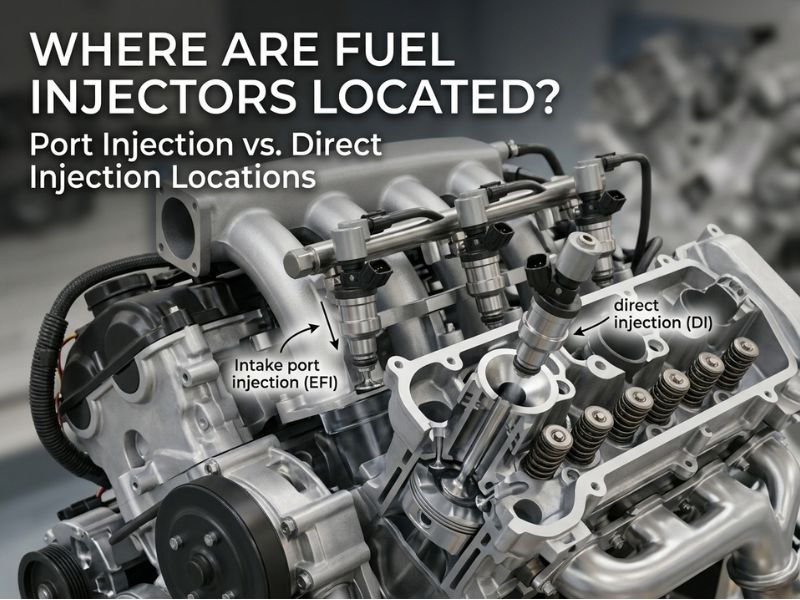
The location of a fuel injector depends primarily on the fuel-injection system used by the engine.
In older systems, fuel may be injected at a central location near the throttle body. In modern engines, individual injectors are generally associated with each cylinder.
Understanding injector location is useful when diagnosing problems because the location determines where the fuel is introduced and how the engine mixes it with incoming air.
Port Fuel Injection
In a port fuel-injection system, each injector is generally positioned near the intake port for its cylinder.
The injector sprays fuel into the intake port, where the fuel mixes with incoming air before entering the combustion chamber.
This arrangement is commonly associated with multi-point fuel injection (MPFI) or similar port-injection systems.
The injector is often mounted in or around the intake manifold and connected to a fuel rail that supplies pressurized fuel to multiple injectors.
Direct Fuel Injection
With gasoline direct injection (GDI), the injector is positioned so that it can spray fuel directly into the combustion chamber.
This allows the engine computer to control fuel delivery very precisely and can support different combustion strategies depending on engine design.
Direct-injection systems generally operate at much higher fuel pressures than conventional port-injection systems. Because of this, their components and service procedures can be significantly different.
Throttle-Body Injection
Throttle-body injection (TBI) places one or more injectors in the throttle-body assembly.
Instead of having an individual injector located at each cylinder’s intake port, fuel is introduced near the throttle body and then distributed through the intake system.
TBI was used extensively in older electronically fuel-injected vehicles but is much less common in modern passenger vehicles.
The major difference between these systems is where the fuel enters the engine:
| Injection Type | Fuel Delivery Location |
| Throttle-body injection | Near the throttle body |
| Port injection | Intake port near the intake valve |
| Direct injection | Directly into the combustion chamber |
The location affects how fuel and air are mixed, how the system is controlled, and how the engine’s fuel-delivery system is designed.
Types of Fuel Injectors
Fuel injectors are not all designed the same way. Their construction, operating pressure, location, and control method depend on the type of engine and fuel-injection system.
The main categories you’ll encounter include port fuel injectors, direct fuel injectors, throttle-body injectors, gasoline injectors, and diesel injectors.
Port Fuel Injectors
Port fuel injectors spray fuel into the intake port, usually close to the intake valve. The fuel then mixes with incoming air before entering the combustion chamber.
This type of injection has been widely used in gasoline engines because it provides individual fuel delivery to each cylinder.
Direct Fuel Injectors
Direct fuel injectors spray gasoline directly into the combustion chamber rather than into the intake port.
Because fuel is injected directly into the cylinder, these systems require specialized injectors capable of operating at substantially higher pressures than conventional port-injection systems.
Throttle-Body Injectors
Throttle-body injection places the injector or injectors in the throttle-body assembly.
The fuel is introduced upstream of the intake manifold and then distributed toward the cylinders. This design was common in older electronically fuel-injected vehicles.
Gasoline Fuel Injectors
Gasoline injectors are designed for spark-ignition engines. They can be used in either port-injection or direct-injection systems.
A gasoline injector’s flow characteristics, electrical design, pressure requirements, and physical dimensions must match the engine’s fuel system.
Diesel Fuel Injectors
Diesel fuel injectors operate differently from typical gasoline injectors.
Modern diesel engines commonly use high-pressure direct injection, often as part of a common-rail fuel system. The injector must deliver fuel at precisely controlled times and pressures so the fuel can mix with highly compressed air and ignite.
Diesel injectors therefore have different operating requirements from gasoline injectors and should not be treated as interchangeable components.
Sequential Fuel Injection
With sequential fuel injection, the engine control system coordinates injector operation with the engine’s combustion cycle.
Each injector is controlled according to the position and timing of its corresponding cylinder.
Batch Fuel Injection
In a batch or grouped injection system, multiple injectors may be activated together rather than being individually timed for every combustion event.
This approach is associated more commonly with older fuel-injection systems.
Mechanical vs Electronic Fuel Injectors
Older fuel systems may use mechanical methods to control fuel delivery, while modern systems primarily rely on electronic control.
Electronic injectors allow the ECU to adjust fuel delivery based on changing engine conditions, which provides much more precise control.
Fuel Injection vs Carburetor
Before electronic fuel injection became widespread, many gasoline engines relied on carburetors to mix fuel with incoming air.
Both systems have the same fundamental purpose: supplying an appropriate air-fuel mixture to the engine. The major difference is how that fuel is metered and delivered.
A carburetor uses mechanical airflow and pressure differences to draw and meter fuel. A fuel-injection system uses injectors, fuel pressure, and electronic control to meter fuel more precisely.
How a Carburetor Works
A carburetor uses the movement of air through passages to create a pressure difference that draws fuel into the incoming air stream.
Mechanical components such as jets, floats, and throttle mechanisms control fuel delivery.
The exact operation varies between carburetor designs, but the system generally relies much more heavily on mechanical principles than modern electronic fuel injection.
How Fuel Injection Works
Fuel injection uses a fuel pump, fuel injectors, sensors, and an ECU to control fuel delivery.
The ECU can continuously adjust injector operation according to engine speed, load, temperature, throttle position, and exhaust feedback.
This allows the fuel system to respond rapidly to changing operating conditions.
Key Differences Between Fuel Injection and Carburetion
| Feature | Fuel Injection | Carburetor |
| Fuel metering | Electronically controlled in modern systems | Primarily mechanical |
| Fuel delivery | Through injectors | Through carburetor passages |
| Computer control | Common | Generally absent |
| Cold-start control | ECU-controlled strategies | Choke or other mechanical systems |
| Fuel mixture control | Highly adjustable | More mechanically limited |
| Modern vehicle use | Very common | Mostly older vehicles |
Fuel Injection Advantages
Modern fuel injection offers several practical advantages, including precise fuel metering and better adaptation to changing operating conditions.
The ECU can adjust fuel delivery as the engine warms up, accelerates, cruises, or operates under heavier loads.
Fuel injection can also support modern emissions-control strategies that would be difficult to achieve with a basic carburetor.
Carburetor Advantages
Carburetors are mechanically simpler in some respects and can be serviced without the electronic control systems required by modern fuel injection.
For older vehicles and certain specialized applications, that simplicity can still be useful.
However, carburetors generally do not provide the same level of electronic control over fuel delivery as modern fuel-injection systems.
Main Parts of a Fuel Injector
A fuel injector consists of several components that work together to control fuel flow and produce the required spray.
The exact internal construction varies between injector designs, but understanding the major parts makes it easier to understand how an injector can become restricted, leak, or fail electrically.
Injector Body
The injector body houses the internal components and provides the passages through which fuel travels.
It also provides the physical structure needed to mount the injector securely in the fuel system.
Electrical Connector
The electrical connector connects the injector to the vehicle’s wiring harness.
The ECU sends an electrical control signal through this circuit to operate the injector.
A damaged connector, broken wire, corrosion, or poor electrical connection can prevent an otherwise functional injector from operating correctly.
Solenoid Coil
Many electronic gasoline fuel injectors use a solenoid coil.
When electrical current passes through the coil, it creates a magnetic field that moves the injector’s internal mechanism and opens the fuel valve.
When the electrical command stops, the valve closes.
Armature or Moving Mechanism
The armature is an internal moving component that responds to the magnetic field produced by the solenoid.
Its movement allows the injector valve to open and close rapidly.
Needle or Valve
The internal needle, valve, or equivalent mechanism controls whether fuel can pass through the injector.
When the valve opens, pressurized fuel can reach the nozzle. When it closes, fuel flow stops.
A valve that becomes stuck, contaminated, or damaged can cause incorrect fuel delivery.
Nozzle
The injector nozzle is the outlet through which fuel leaves the injector.
Its small openings help create the desired spray pattern.
Deposits or physical damage around the nozzle can interfere with fuel atomization and flow.
Internal Filter
Some injectors contain a small internal filter designed to help prevent contaminants from reaching sensitive internal components.
If contamination accumulates in the fuel system, the filter or injector passages can become restricted.
O-Rings and Seals
Fuel injectors commonly use O-rings or other seals where they connect to the fuel rail, intake manifold, or cylinder head.
These seals help prevent fuel leaks and, depending on the installation, can also help prevent unwanted air from entering the intake system.
Damaged, hardened, incorrectly installed, or reused seals can create problems even when the injector itself is functioning correctly.
How These Parts Work Together
All of these components have a specific role.
Fuel enters the injector under pressure. The ECU controls the electrical circuit, the internal valve opens, and fuel passes through the nozzle. When the electrical signal ends, the valve closes and stops fuel delivery.
Because the injector operates repeatedly and precisely, problems with the electrical circuit, valve, nozzle, seals, or fuel supply can affect engine operation.
How Fuel Injectors Work With the Rest of the Fuel System
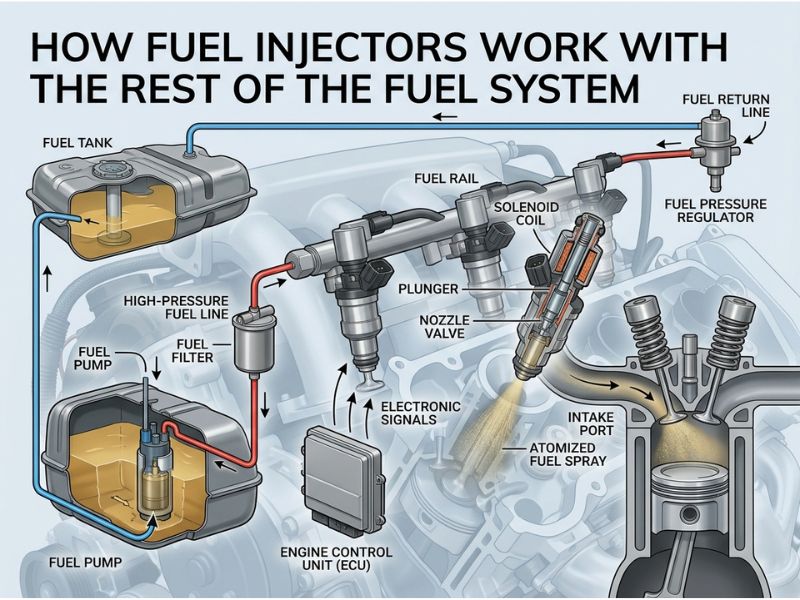
A fuel injector is only one part of the vehicle’s fuel-delivery system. It depends on several other components to receive clean, pressurized fuel and deliver it to the engine at the correct time.
A typical gasoline fuel system can be thought of as a chain: fuel tank → fuel pump → fuel filter → fuel lines → fuel rail → fuel injectors → engine.
The exact design varies by vehicle, especially between port-injection, direct-injection, and diesel systems.
Fuel Tank
The fuel tank stores the vehicle’s fuel.
A fuel pump assembly is commonly located inside or near the tank. The tank also works with components designed to control fuel vapor and maintain the required fuel-system conditions.
Contaminated fuel, water, rust, or debris in the tank can eventually make its way into the fuel system and contribute to injector problems.
Fuel Pump
The fuel pump moves fuel from the tank toward the engine.
It must provide the fuel pressure and flow required by the particular fuel system. If the pump cannot supply enough fuel, the injectors may not receive the conditions they need for proper fuel delivery.
A fuel-pump problem can therefore produce symptoms that resemble injector problems, including poor acceleration, hard starting, or engine hesitation.
Fuel Filter
The fuel filter helps remove contaminants from the fuel before they reach sensitive fuel-system components.
A restricted filter can reduce fuel flow and potentially affect fuel pressure, depending on the system design.
This is one reason fuel-system maintenance should follow the vehicle manufacturer’s recommendations.
Fuel Lines
Fuel lines carry fuel between the tank, pump, filter, fuel rail, and other components.
The construction and routing of these lines vary by vehicle.
A damaged, restricted, or leaking fuel line can affect fuel delivery and create a safety concern.
Fuel Rail
The fuel rail supplies fuel to multiple injectors on many engines.
In a port-injected gasoline engine, the injectors are commonly mounted along the fuel rail so each cylinder can receive fuel.
Some direct-injection systems use specialized high-pressure fuel rails because their operating pressures are much higher.
Fuel Pressure Regulator
The fuel-pressure control system maintains or regulates the pressure required by the fuel system.
Depending on the vehicle, pressure regulation may be handled by a dedicated regulator, a fuel-pump module, or another electronically controlled component.
Incorrect fuel pressure can affect injector flow and therefore change how much fuel actually enters the engine.
Fuel Injectors
The injectors are the final controlled delivery point in this basic fuel path.
They receive fuel from the fuel system and use an electrical or mechanical control mechanism to meter it into the engine.
The injector cannot compensate for every fuel-system problem. For example, an injector may be perfectly functional but still deliver inadequate fuel if the fuel pressure or supply is incorrect.
ECU or PCM
The engine control unit (ECU) or powertrain control module (PCM) controls injector operation in modern electronically fuel-injected vehicles.
It determines when and how long the injectors should operate based on sensor information and programmed control strategies.
This means fuel-injector diagnosis should not always stop at the injector itself. The surrounding fuel supply and electrical control system also need to be considered.
What Controls Fuel Injector Operation?
Modern fuel injectors are controlled by a combination of the ECU, electrical circuits, sensors, fuel pressure, and engine operating conditions.
The ECU needs to know what the engine is doing before it can determine how much fuel to deliver.
Engine Control Unit
The ECU is the central computer responsible for managing many aspects of engine operation.
For fuel injection, it processes information from various sensors and calculates an appropriate injector command.
The ECU may control:
- Injector timing
- Injector pulse width
- Fuel enrichment during certain conditions
- Fuel delivery during acceleration
- Fuel delivery during deceleration
- Closed-loop fuel corrections
The exact strategy depends on the vehicle and engine-management system.
Crankshaft Position Sensor
The crankshaft position sensor tells the ECU where the crankshaft is and how quickly it is rotating.
This information is essential for determining engine speed and coordinating fuel injection with the engine’s operating cycle.
A problem with this sensor can interfere with injector timing and may cause starting or running problems.
Camshaft Position Sensor
The camshaft position sensor provides information about camshaft position.
The ECU can use this information to determine which cylinder is in a particular part of its combustion cycle and to coordinate injection and ignition strategies.
MAF Sensor
The mass airflow (MAF) sensor measures the amount of air entering the engine in systems that use MAF-based airflow calculation.
The ECU can use this information to estimate how much fuel is required to maintain the desired mixture.
A faulty or contaminated MAF sensor can therefore affect fuel control without there being anything physically wrong with the injectors.
MAP Sensor
The manifold absolute pressure (MAP) sensor measures pressure in the intake manifold.
Depending on the engine-management strategy, the ECU can use MAP information along with engine speed and other inputs to calculate engine load and determine appropriate fuel delivery.
Throttle Position Sensor
The throttle position sensor (TPS) provides information about throttle position.
The ECU uses throttle information to understand driver demand and changing engine conditions.
When the throttle opens rapidly, for example, the fuel system may need to respond quickly to the changing airflow and engine load.
Engine Coolant Temperature Sensor
The engine coolant temperature sensor tells the ECU how warm or cold the engine is.
Fuel requirements can change substantially between a cold start and a fully warmed engine.
The ECU uses temperature information to adjust fuel delivery and other engine-control functions.
Oxygen and Air-Fuel Ratio Sensors
Sensors in the exhaust system provide feedback about combustion and the resulting exhaust gases.
In many gasoline engines, the ECU uses this information for closed-loop fuel control.
This allows the system to make adjustments rather than relying solely on a fixed fuel calculation.
Fuel Pressure
The injector also depends on the correct fuel pressure.
Even if an injector receives the correct electrical command, abnormal fuel pressure can change the amount of fuel that actually flows through it.
For this reason, fuel-pressure testing can be an important part of diagnosing suspected injector problems.
What Happens When Fuel Injectors Spray Fuel?
When a fuel injector opens, pressurized fuel passes through a very small outlet and is formed into a controlled spray.
The goal is not simply to put fuel into the engine. The fuel needs to be delivered in a way that allows it to mix effectively with incoming air and support efficient combustion.
The exact injection strategy depends on whether the engine uses port injection, direct injection, or another system.
Fuel Atomization
Atomization means breaking liquid fuel into very small droplets.
A properly functioning injector produces a spray pattern appropriate for its application. Smaller droplets generally provide more surface area for interaction with air, although the ideal spray characteristics depend on the injector and engine design.
The nozzle’s design, fuel pressure, injector geometry, and control strategy all influence the resulting spray.
Spray Pattern
The spray pattern is the shape and distribution of fuel leaving the injector.
Different engines and injectors can require different spray patterns.
A restricted nozzle may distort the intended pattern. Instead of producing the designed spray, it may deliver fuel unevenly.
This is one reason professional injector testing can be useful when an injector is suspected of malfunctioning.
Air-Fuel Mixing
After fuel leaves the injector, it needs to mix with air appropriately.
In a port-injected engine, this mixing begins in the intake port and intake manifold before the mixture enters the cylinder.
In a direct-injection engine, fuel is introduced directly into the combustion chamber, and the engine’s design determines how fuel and air interact inside the cylinder.
Combustion
Once the appropriate mixture is present in the cylinder, combustion can occur.
In a gasoline engine, the spark plug provides the ignition source. In a diesel engine, fuel is injected into highly compressed air and the combustion process follows a different principle.
If the injector delivers too little fuel, too much fuel, or an unsuitable spray pattern, combustion quality can suffer.
Exhaust and Feedback
After combustion, exhaust gases leave the cylinder and pass through the exhaust system.
Exhaust sensors can provide feedback to the ECU about combustion and mixture conditions.
The ECU can then use that information to make fuel-control adjustments under appropriate operating conditions.
This creates a continuous control process rather than a simple one-time fuel calculation.
What Does a Good Fuel Injector Look Like?
A good fuel injector is not necessarily something you can judge by looking at its exterior. An injector can appear clean and undamaged while having an internal electrical, mechanical, or flow problem.
The more useful question is whether the injector delivers the correct amount of fuel, produces the intended spray pattern, opens and closes properly, and seals correctly.
A properly functioning injector should have characteristics that match the engine manufacturer’s specifications.
Proper Spray Pattern
The injector should produce the spray pattern it was designed to produce.
The exact pattern depends on the injector and engine. Some applications use a narrow spray, while others use a wider or specially shaped pattern designed for the intake port or combustion chamber.
A distorted, uneven, or weak spray can indicate contamination, nozzle damage, or another injector problem.
Correct Fuel Delivery
An injector needs to deliver the appropriate amount of fuel for the engine’s operating conditions.
Two injectors installed on the same engine should generally provide consistent flow when tested under the same conditions and according to the applicable specifications.
An injector that flows significantly less or more than expected may cause that cylinder to operate differently from the others.
Correct Electrical Operation
An electronically controlled injector needs to respond correctly to its electrical command.
The injector’s electrical characteristics must be within the manufacturer’s specified range, and the wiring and connector must provide a reliable connection.
An injector can therefore fail even when its nozzle is clean if its internal electrical components are damaged.
Proper Sealing
The injector must also seal correctly where it is installed.
Damaged or improperly installed O-rings and seals can allow fuel to leak or, depending on the location, allow unwanted air into the intake system.
A fuel leak around an injector should never be ignored because fuel is highly flammable.
Stable Fuel Delivery
A healthy injector should open and close consistently rather than sticking intermittently.
A valve that sticks open can allow excessive fuel into a cylinder. A valve that remains closed or opens insufficiently can restrict fuel delivery.
These different failure modes can produce very different engine symptoms.
What Causes Fuel Injectors to Get Dirty?
Fuel injectors operate in an environment where they are repeatedly exposed to fuel, heat, and engine-related contaminants.
Over time, deposits can form on or inside the injector, potentially affecting its flow characteristics or spray pattern.
Not every injector problem is caused by dirt, however. Electrical failures, mechanical wear, damaged seals, fuel-pressure problems, and wiring faults can produce similar symptoms.
Fuel Deposits
Fuel can leave deposits as it passes through the injector and is exposed to heat.
The exact amount and type of deposit formation depend on the fuel system, injector design, fuel characteristics, engine operating conditions, and other factors.
Deposits can affect the injector nozzle and interfere with its intended spray.
Carbon Deposits
Carbon and other combustion-related deposits can affect components around the fuel-injection system.
Direct-injection engines can have different deposit patterns from port-injected engines because fuel is introduced into the combustion chamber rather than sprayed onto the back of the intake valve.
The presence of carbon does not automatically mean an injector itself is defective, so the location and nature of the deposit matter.
Contaminated Fuel
Fuel containing dirt, water, rust particles, or other contaminants can introduce unwanted material into the fuel system.
The fuel filter provides protection, but severe contamination can still create problems.
Contaminated fuel can affect the fuel pump, fuel lines, fuel rail, injectors, and other fuel-system components.
Long-Term Vehicle Storage
Vehicles that sit unused for extended periods can develop fuel-system issues depending on storage conditions and the fuel remaining in the system.
Fuel can degrade over time, and moisture or contamination can become a concern.
If a vehicle will be stored for a long period, follow the storage recommendations provided by the vehicle and fuel-system manufacturers.
Poor Fuel Filtration
A fuel filter that is damaged, incorrectly fitted, or excessively restricted can create fuel-delivery problems.
The filter’s design and replacement requirements vary by vehicle.
Some modern vehicles have fuel filters integrated into the fuel-pump module or designed for long service intervals, so replacement should follow the manufacturer’s specifications.
Internal Injector Deposits
Deposits can accumulate around the injector’s internal passages or nozzle.
Even a relatively small restriction can affect fuel flow because injector openings are precisely engineered.
The result may be an altered spray pattern or reduced flow rather than a complete blockage.
Externally Dirty vs Internally Restricted Injectors
It is important to distinguish between an injector that looks dirty from the outside and one that has an internal flow problem.
A dirty exterior does not necessarily affect fuel delivery.
Likewise, an injector can look perfectly clean externally while having restricted internal passages, an electrical fault, or a damaged valve.
Proper testing is more reliable than judging injector condition by appearance alone.
Symptoms of Dirty Fuel Injectors
Dirty fuel injectors can produce a range of symptoms because contamination may affect fuel flow or spray quality.
However, these symptoms overlap with many other engine problems. A rough idle, for example, can be caused by an injector, spark plug, ignition coil, vacuum leak, sensor issue, compression problem, or fuel-pressure fault.
For that reason, symptoms should be treated as diagnostic clues rather than proof of injector contamination.
Read More: can a dirty fuel injector cause high revs
Rough Idle
A restricted injector may deliver fuel unevenly to one cylinder.
If that cylinder does not receive the fuel it needs for stable combustion, the engine may idle roughly or vibrate.
The roughness may be more noticeable at idle because the engine has less rotational momentum and less combustion energy available to mask small differences between cylinders.
Engine Misfire
A dirty injector can contribute to a misfire if fuel delivery becomes inadequate.
The engine may detect a difference in crankshaft acceleration and store a cylinder-specific or random misfire code, depending on the severity and system design.
However, ignition and mechanical problems can cause exactly the same type of symptom.
Poor Acceleration
If an injector cannot provide sufficient fuel when engine demand increases, the vehicle may hesitate or feel less responsive during acceleration.
The problem can become more noticeable when climbing a hill, carrying a heavy load, or accelerating quickly.
Hesitation
Hesitation occurs when the engine does not respond smoothly to a change in throttle demand.
A restricted injector can contribute to this condition by limiting fuel delivery, but an airflow sensor, ignition component, fuel-pressure issue, or throttle-control problem can also be responsible.
Hard Starting
A fuel injector that is significantly restricted or otherwise malfunctioning can contribute to difficult starting.
Starting requires an appropriate combination of fuel, air, compression, and ignition. A problem with any of these areas can create similar symptoms.
Poor Fuel Economy
Injector problems can affect fuel economy when they disturb the intended air-fuel mixture or combustion process.
However, increased fuel consumption has many possible causes, including low tire pressure, driving conditions, thermostat problems, sensor faults, ignition problems, fuel-pressure issues, and mechanical problems.
Therefore, poor mileage alone is not enough to condemn an injector.
Engine Stalling
A severe fuel-delivery problem can contribute to stalling.
If fuel delivery becomes insufficient or combustion becomes unstable enough, the engine may fail to maintain idle speed.
A stalling engine should be diagnosed systematically because fuel, ignition, airflow, electrical, and mechanical faults can all produce this symptom.
Surging or Fluctuating RPM
Injector problems can sometimes contribute to RPM fluctuations when fuel delivery becomes inconsistent.
The engine control system may respond to changing combustion conditions, producing an unstable idle or surging behavior.
If the engine consistently runs at a high idle, however, investigate possible vacuum leaks, throttle-body problems, idle-control faults, and other airflow issues rather than assuming dirty injectors are responsible.
Check Engine Light
An injector-related problem can trigger the check engine light if the engine control system detects conditions such as a misfire or an abnormal air-fuel mixture.
The diagnostic trouble code can help direct the investigation, but it does not necessarily identify the injector as the failed component.
A cylinder misfire code, for example, tells you that combustion is abnormal in that cylinder. The cause could be the injector, spark plug, ignition coil, compression, wiring, or another problem.
Increased Emissions
Poor fuel atomization or incorrect fuel delivery can affect combustion quality and emissions.
The vehicle’s emissions-control system is designed to compensate for certain variations, but it has limits.
A persistent injector problem can therefore contribute to emissions-related faults as well as drivability problems.
The combination of symptoms, diagnostic codes, live data, and appropriate testing provides a much stronger diagnosis than any single symptom.
Symptoms of a Bad or Failing Fuel Injector
A bad or failing fuel injector can cause rough running, misfires, hesitation, hard starting, poor acceleration, or increased fuel consumption. The exact symptoms depend on whether the injector is restricted, electrically failed, stuck open, leaking, or delivering fuel inconsistently.
Because many engine problems produce similar symptoms, an injector should not be replaced based on symptoms alone. Testing the injector and checking the rest of the fuel and ignition systems can help identify the actual cause.
Rough Engine Idle
A failing injector may cause one cylinder to receive too little or too much fuel.
When combustion becomes inconsistent, the engine may shake, vibrate, or feel rough while idling. The problem may become less noticeable as engine speed increases, although that is not always the case.
Engine Misfire
A malfunctioning injector can cause a cylinder to misfire when fuel delivery is insufficient or excessive.
A vehicle may store a misfire diagnostic trouble code, but a misfire code does not automatically prove that the injector is defective. Spark plugs, ignition coils, compression, vacuum leaks, and wiring can produce similar results.
Poor Acceleration
If an injector cannot provide enough fuel when engine demand increases, the engine may feel weak during acceleration.
The driver may notice sluggish response when pressing the accelerator, particularly when climbing a hill or accelerating under load.
Hesitation or Surging
An injector that delivers fuel inconsistently can cause hesitation or an uneven response to throttle input.
In some cases, the engine may surge because combustion is changing as fuel delivery fluctuates.
These symptoms can also result from problems with the throttle body, airflow sensors, fuel pressure, ignition system, or engine control system.
Hard Starting or No-Start
A severely malfunctioning injector can contribute to difficult starting.
If an injector does not deliver enough fuel, the engine may crank without establishing normal combustion. On the other hand, an injector that leaks excessively can introduce too much fuel and create a rich starting condition.
A no-start condition should always be diagnosed as a complete fuel, ignition, compression, and electrical problem rather than assuming the injectors are responsible.
Increased Fuel Consumption
An injector that leaks or delivers excessive fuel can cause the engine to run richer than intended.
The ECU may detect the resulting air-fuel imbalance and attempt to correct it, but the correction has limits.
If fuel economy suddenly drops, check for injector problems along with fuel-pressure issues, sensor faults, ignition problems, tire pressure, driving conditions, and other causes.
Fuel Odor
A strong gasoline or diesel fuel smell can indicate a fuel leak or excessive fuel delivery.
Fuel odor around the engine compartment, injector area, or exhaust should be taken seriously.
If you can see fuel leaking, avoid operating the vehicle and address the leak before continuing to drive it. Fuel is highly flammable.
Black Smoke From the Exhaust
Excessive fuel delivery can produce a rich combustion condition and, on some engines, visible dark exhaust smoke.
This symptom is more strongly associated with excessive fueling than with a simple restricted injector.
The exact appearance and significance of exhaust smoke depend on the engine and fuel type, so other causes should also be considered.
Check Engine Light
A failing injector can trigger the check engine light through misfire detection, fuel-trim abnormalities, or other monitored conditions.
Reading the diagnostic trouble codes is a useful starting point, but the code should be interpreted alongside testing and other evidence.
Fuel Leak Around the Injector
A damaged injector body, seal, O-ring, connection, or fuel-system component can result in an external fuel leak.
This is different from an injector that is leaking internally into the engine.
An external fuel leak is a safety issue and should be repaired before normal vehicle operation.
Can a Bad Fuel Injector Cause?
A bad fuel injector can cause many different drivability problems because fuel delivery is directly connected to combustion. However, an injector is only one possible cause of most engine symptoms.
Understanding what an injector can cause—and what else can create the same symptom—helps prevent unnecessary parts replacement.
Can a Bad Fuel Injector Cause a Car Not to Start?
Yes, a severely faulty fuel injector can contribute to a no-start condition.
If one or more injectors fail to deliver fuel, the engine may not receive the fuel required for combustion. An injector that is stuck open can also cause excessive fueling and make starting difficult.
However, a no-start condition can also result from a weak fuel pump, low fuel pressure, ignition failure, crankshaft position sensor problems, immobilizer issues, poor compression, or electrical faults.
Can a Bad Fuel Injector Cause a Misfire?
Yes. A faulty injector can cause a cylinder to misfire if it delivers too little fuel, too much fuel, or fuel inconsistently.
A misfire should still be diagnosed systematically because ignition, compression, air leaks, and other fuel-system problems can produce the same symptom.
Can a Bad Fuel Injector Cause Rough Idle?
Yes. An injector that does not deliver fuel consistently can make one cylinder produce less stable combustion, resulting in a rough or uneven idle.
A rough idle can also come from vacuum leaks, spark plugs, ignition coils, throttle-body problems, sensors, or engine mechanical issues.
Can a Bad Fuel Injector Cause Poor Acceleration?
Yes. An injector that cannot provide adequate fuel under increased engine demand may contribute to hesitation or weak acceleration.
The problem may be particularly noticeable when accelerating quickly or driving under a heavy load.
Can a Bad Fuel Injector Cause Poor Fuel Economy?
Yes. An injector that leaks or delivers excessive fuel can contribute to increased fuel consumption.
However, poor fuel economy is not specific to injectors. Tire pressure, driving habits, fuel pressure, oxygen or air-fuel sensors, ignition problems, and other engine issues can also increase fuel consumption.
Can a Bad Fuel Injector Cause Black Smoke?
Yes, an injector that delivers excessive fuel can contribute to a rich mixture and black exhaust smoke, particularly on engines where excess fuel is visibly expelled as soot.
A black-smoke condition should be investigated rather than assuming the injector is the only cause.
Can a Bad Fuel Injector Cause a Check Engine Light?
Yes. Injector problems can trigger the check engine light when they cause detectable misfires or abnormal fuel-mixture conditions.
The stored diagnostic code can provide useful direction, but further testing is normally needed before replacing an injector.
Can a Bad Fuel Injector Cause Engine Stalling?
Yes. A serious injector problem can contribute to stalling if fuel delivery becomes insufficient or combustion becomes unstable.
Because stalling can also be caused by ignition, electrical, airflow, fuel-pressure, or sensor problems, the complete system should be checked.
Can a Bad Fuel Injector Damage the Engine?
A severely malfunctioning injector can potentially contribute to engine damage if the condition causes persistent excessive fueling, severe misfire, or other abnormal combustion conditions.
For example, an injector that remains open can introduce excessive fuel into a cylinder. Depending on the engine and severity, this can affect lubrication or combustion.
A persistent injector problem should therefore be diagnosed rather than ignored.
What Causes Fuel Injector Failure?
Fuel injectors can fail because of contamination, electrical problems, mechanical wear, heat exposure, damaged seals, fuel-system problems, or physical damage.
Not every injector that shows symptoms has actually failed internally. A wiring fault, poor electrical connection, low fuel pressure, or another fuel-system problem can make a healthy injector appear faulty.
Contamination and Deposits
Fuel contamination and deposits can restrict the injector’s internal passages or affect the nozzle.
A restricted injector may deliver less fuel than intended or produce an altered spray pattern.
Electrical Failure
Electronic fuel injectors depend on an electrical circuit to operate.
A failed internal coil, damaged connector, broken wire, poor ground, or control-circuit problem can prevent the injector from operating correctly.
An electrical problem should be distinguished from a clogged injector because cleaning will not repair a failed electrical component.
Sticking Injector Valve
The internal valve or moving mechanism needs to open and close consistently.
Contamination, deposits, or mechanical wear can interfere with its movement.
An injector that sticks closed or does not open sufficiently can restrict fuel delivery, while one that sticks open can allow excessive fuel into the engine.
Damaged O-Rings or Seals
Injector seals can deteriorate, become damaged during installation, or fail because of age and heat.
A damaged seal can create a fuel leak or, depending on the injector’s location, an unwanted air leak.
Whenever an injector is removed, the applicable sealing components should be inspected and replaced when required by the vehicle manufacturer.
Excessive Heat
Fuel injectors operate in a hot engine environment.
Repeated exposure to high temperatures can contribute to deterioration of electrical components, seals, and other materials over time.
The injector’s exact operating environment depends on its location and engine design.
Fuel-System Problems
Problems elsewhere in the fuel system can affect injector operation.
Incorrect fuel pressure, a restricted filter, a failing fuel pump, contaminated fuel, or a faulty pressure-control component can create symptoms that appear to be injector-related.
This is why injector diagnosis should include the surrounding fuel system.
Incorrect Injector Installation
An injector can develop problems after improper installation.
Damaged O-rings, incorrect seating, contaminated installation surfaces, incorrect connectors, or using an incompatible injector can create fuel leaks or operating problems.
Following the vehicle manufacturer’s installation procedure is important, particularly because fuel-system components can be under pressure.
Age and Wear
Fuel injectors are precision components that repeatedly cycle during engine operation.
Over a long service life, internal components, electrical components, seals, and nozzle surfaces can experience wear.
There is no single universal mileage at which every injector fails, so condition and testing are more useful than replacing injectors simply because they have reached a particular mileage.
How to Diagnose a Bad Fuel Injector
Diagnosing a bad fuel injector starts with confirming that the problem is actually related to fuel delivery. Symptoms such as rough idle, misfire, hesitation, hard starting, and poor acceleration can also be caused by ignition, air intake, compression, sensors, wiring, or fuel-pressure problems.
A good diagnosis therefore moves from basic observations to targeted testing rather than immediately replacing the injector.
Start With the Symptoms
Pay attention to when the problem occurs.
For example, a rough idle may point toward a cylinder-specific combustion problem, while hesitation under load may indicate a fuel-delivery issue that becomes more noticeable as engine demand increases.
Note whether the vehicle has:
- Rough idle
- Misfires
- Hard starting
- Poor acceleration
- Reduced fuel economy
- Engine stalling
- Fuel odor
- Check engine light
- Uneven engine operation
These observations help determine which tests should be performed next.
Scan for Diagnostic Trouble Codes
Connect a compatible OBD2 scanner and check for stored and pending diagnostic trouble codes.
Codes related to cylinder misfires, fuel mixture, or injector circuits can provide useful clues.
However, a code does not always identify the failed component. For example, a cylinder misfire code can be caused by an injector, spark plug, ignition coil, compression problem, vacuum leak, or wiring fault.
The code should therefore be treated as a starting point for diagnosis.
Check the Injector Electrical Connection
Inspect the injector connector and wiring for obvious problems.
Look for loose connections, damaged wires, corrosion, broken insulation, or signs that the connector is not locking properly.
A poor electrical connection can interrupt injector operation and create symptoms that look like an injector failure.
Check Fuel Pressure
Fuel pressure is an important part of injector diagnosis.
If pressure is too low or otherwise outside the vehicle manufacturer’s specification, multiple injectors may appear to have poor fuel delivery even when the injectors themselves are functioning correctly.
The correct pressure specification and testing procedure vary by vehicle and injection system.
Compare Cylinder Operation
If the engine has a cylinder-specific problem, compare that cylinder with the others.
A technician may use diagnostic scan data, cylinder contribution information, or controlled tests to determine whether one cylinder is behaving differently.
A difference between cylinders can help narrow the problem toward a specific injector or another component serving that cylinder.
Check Injector Resistance When Applicable
Some electronically controlled injectors can be checked with a multimeter by measuring electrical resistance across the appropriate terminals.
The measured value must be compared with the manufacturer’s specification for that particular injector.
A resistance reading outside the specified range can indicate an internal electrical problem.
However, a resistance test alone cannot prove that an injector has the correct fuel flow or spray pattern.
Listen for Injector Operation
A technician can sometimes listen for the characteristic clicking of an electronically controlled injector while the engine is running or during an appropriate test.
The sound can provide a useful clue that the injector is being actuated.
However, hearing an injector click does not prove that it is delivering the correct amount of fuel. An injector can make a normal sound while being restricted, leaking, or otherwise malfunctioning.
Check for Fuel Leakage
Inspect the injector area for signs of external fuel leakage when it is safe to do so.
Fuel around an injector, rail connection, or seal should be addressed immediately.
Never use an open flame to look for fuel leaks, and do not continue operating a vehicle with an obvious fuel leak.
Consider Other Causes
Before condemning an injector, check other components that can produce similar symptoms.
These may include:
- Spark plugs
- Ignition coils
- Fuel pump
- Fuel filter
- Fuel-pressure regulator or control system
- MAF or MAP sensor
- Throttle body
- Vacuum leaks
- Crankshaft or camshaft position sensors
- Engine compression
- Injector wiring
A systematic diagnosis reduces the chance of replacing a good injector unnecessarily.
How to Test Fuel Injectors
Testing fuel injectors involves checking their electrical operation, fuel delivery, and mechanical condition. The appropriate test depends on the injector type and the vehicle.
Some basic checks can be performed with common diagnostic equipment, while accurate flow and spray testing may require specialized equipment.
Visual Inspection
Begin with a visual inspection of the injector and surrounding components.
Check the injector body, connector, wiring, fuel rail connection, and visible seals for damage or fuel leakage.
Look for signs of corrosion, damaged wiring, loose connectors, or deteriorated O-rings.
Electrical Resistance Test
A multimeter can be used on applicable injectors to measure resistance across the injector’s electrical terminals.
Compare the result with the manufacturer’s specification.
If the measurement is significantly outside the specified range, the injector may have an internal electrical fault.
This test has limitations because an injector can have acceptable resistance while still suffering from restricted fuel flow or a mechanical problem.
Injector Noid Light Test
A noid light can be used on certain systems to check whether the injector connector is receiving an appropriate pulsing electrical signal.
The light connects to the injector’s electrical connector in place of the injector.
A visible pulse can indicate that the control circuit is attempting to operate the injector.
It does not confirm that the injector itself is mechanically functioning or delivering the correct fuel quantity.
Listening Test
An injector may produce a clicking sound as its internal mechanism operates.
A mechanic can use a suitable listening tool to compare injector operation between cylinders.
If one injector sounds different from the others, it may justify additional testing.
Again, clicking does not prove correct fuel flow.
Fuel Pressure Test
A fuel-pressure test can determine whether the fuel system is supplying pressure within the applicable specification.
Low or unstable fuel pressure can affect multiple injectors.
This test is especially useful when several cylinders show similar symptoms.
The testing method differs substantially between traditional port injection and high-pressure direct-injection systems, so the correct procedure and equipment are important.
Injector Balance Test
An injector balance test compares how much fuel-pressure change occurs when individual injectors are commanded to operate under controlled conditions.
The goal is to identify significant differences between injectors.
An injector that produces a substantially different result from the others may require further testing.
The exact procedure varies by vehicle and fuel-system design.
Injector Flow Test
A professional injector test bench can measure fuel flow under controlled conditions.
This allows technicians to compare injectors for:
- Flow rate
- Spray pattern
- Leakage
- Electrical operation
- Consistency between injectors
Bench testing can be particularly useful when an injector problem is suspected but vehicle-based tests have not provided a clear answer.
Spray Pattern Test
The spray pattern can provide information about injector condition.
A properly functioning injector should produce the spray characteristics specified for its application.
A distorted, weak, uneven, or irregular spray can indicate contamination, mechanical damage, or another injector problem.
Because pressurized fuel can be dangerous, spray testing should be performed only with equipment and procedures designed for the injector being tested.
Test the Injector Control Circuit
An injector may be perfectly functional while its control circuit has a problem.
Testing can include checking power supply, wiring continuity, connector condition, and the ECU-controlled circuit according to the vehicle’s service procedure.
This distinction is important because replacing an injector will not repair a wiring or control-module problem.
Compare Results Rather Than Relying on One Test
No single injector test can identify every possible failure.
For example, an injector may pass an electrical resistance test but fail a flow test. Another may have normal flow but leak when it should be closed.
The strongest diagnosis comes from combining scan data, electrical testing, fuel-pressure testing, injector testing, and the vehicle’s symptoms.
How to Clean Fuel Injectors
Fuel injectors can sometimes be cleaned when deposits or contamination are affecting their operation. Cleaning may restore acceptable performance when the injector is dirty but mechanically and electrically functional.
However, cleaning is not a universal repair. A damaged coil, broken injector body, severe mechanical failure, or other internal defect may require replacement instead.
Fuel Injector Cleaner in the Fuel Tank
The simplest cleaning method is a fuel-system cleaning additive designed for use in the vehicle’s fuel tank.
The additive mixes with the fuel and passes through the injectors during normal engine operation.
This approach may help reduce certain deposits, but its effectiveness depends on the type and severity of contamination.
It should not be expected to repair an electrically failed or mechanically damaged injector.
Professional On-Car Cleaning
A professional cleaning service can connect specialized equipment to the vehicle’s fuel system and run a concentrated cleaning solution through the injectors.
This method can provide more controlled cleaning than simply adding an additive to the fuel tank.
The appropriate procedure depends on the vehicle and injection system.
Off-Car Injector Cleaning
For more thorough service, injectors can be removed and cleaned using specialized equipment.
A professional injector-cleaning machine may test the injectors before and after cleaning to compare flow, spray pattern, and leakage.
This provides more information than simply cleaning the injector without measuring its condition.
Ultrasonic Injector Cleaning
Some professional services use ultrasonic cleaning to help remove deposits from injector components.
The injector is placed in an ultrasonic cleaning system while being serviced according to the equipment manufacturer’s procedure.
After cleaning, the injector can be tested to determine whether its flow and spray characteristics have improved.
Replace Damaged Seals
If an injector is removed for cleaning, inspect its O-rings and other applicable seals.
A damaged seal can cause fuel leakage even when the injector itself is functioning correctly.
Replacement seals should be compatible with the injector and vehicle application.
Do Not Assume Cleaning Fixes Every Injector
Cleaning is most appropriate when contamination is the actual problem.
If testing identifies an internal electrical failure, damaged valve, cracked body, severe leakage, or another mechanical defect, cleaning may not solve the problem.
The decision to clean or replace should therefore be based on the injector’s condition and test results.
Fuel-System Safety During Cleaning
Fuel systems can contain pressurized fuel, and gasoline and diesel fuel can present significant fire and exposure hazards.
Work should be performed with the correct equipment, ventilation, protective equipment, and manufacturer-recommended procedures.
Never smoke or use an open flame around an exposed fuel system.
If you are not experienced with pressurized fuel-system service, professional cleaning is the safer option.
How Often Should Fuel Injectors Be Cleaned?
There is no universal mileage or time interval for cleaning fuel injectors. Modern fuel injectors are generally designed to operate for a long service life, so routine cleaning is not automatically required at a specific mileage on every vehicle.
The appropriate approach depends on the vehicle manufacturer’s maintenance schedule, fuel system design, fuel quality, driving conditions, and the actual condition of the injectors.
Follow the Vehicle Manufacturer’s Recommendations
Start with the maintenance information for your specific vehicle.
Some manufacturers may recommend fuel-system maintenance at particular intervals, while others may not specify routine injector cleaning at all.
The requirements can also differ between port fuel injection, direct fuel injection, gasoline engines, and diesel engines.
Consider the Vehicle’s Symptoms
Injector cleaning becomes more relevant when there are symptoms that could reasonably be related to deposits or restricted fuel flow.
Examples include:
- Rough idle
- Hesitation
- Reduced acceleration
- Certain types of misfire
- Poor engine response
- Changes in fuel economy
These symptoms do not automatically mean the injectors need cleaning. Proper diagnosis should come first.
Fuel Quality and Driving Conditions Matter
Fuel quality, contamination, operating temperature, driving patterns, and vehicle storage conditions can influence deposit formation.
A vehicle that regularly operates under demanding conditions may experience different fuel-system conditions from one that is driven gently and maintained according to the manufacturer’s recommendations.
This is one reason a fixed cleaning interval does not work equally well for every vehicle.
Cleaning Too Often Is Not Necessarily Better
More frequent injector cleaning does not automatically improve engine performance.
If the injectors are operating correctly and there is no evidence of contamination, unnecessary cleaning can add cost without solving an existing problem.
It is generally more useful to identify the cause of a drivability problem before performing fuel-system service.
When Professional Cleaning Makes Sense
Professional cleaning can be useful when testing indicates restricted flow, an abnormal spray pattern, or deposits that may be affecting injector performance.
A professional service can often test the injectors before and after cleaning, making it easier to determine whether cleaning actually improved their condition.
Can Fuel Injector Cleaner Actually Work?
Yes, fuel injector cleaner can help reduce certain fuel-system deposits, but its effectiveness depends on the product, injector condition, type of deposit, and severity of the problem.
A fuel additive cannot repair every type of injector failure. It is fundamentally different from repairing an electrical fault, replacing a damaged injector, or correcting a fuel-pressure problem.
How Fuel Injector Cleaner Works
Fuel injector cleaners are formulated with detergent or cleaning chemicals intended to help control or remove certain deposits as the treated fuel passes through the fuel system.
Because the cleaner travels with the fuel, it may help address deposits that are accessible to the fuel and cleaning chemistry.
The result depends heavily on how severe the contamination is.
When Fuel Injector Cleaner May Help
A fuel-system cleaner may be useful when an injector has relatively light deposits that are affecting fuel delivery or spray quality.
It may also be used as part of preventive fuel-system maintenance when recommended by the vehicle or product manufacturer.
However, noticeable improvement should not be assumed in every vehicle.
When Fuel Injector Cleaner Is Unlikely to Help
A bottle of cleaner is unlikely to repair a fundamentally damaged injector.
For example, it cannot normally fix:
- A failed injector coil
- Broken electrical wiring
- A cracked injector body
- Severely damaged internal components
- A badly damaged valve
- A significant external fuel leak
- An injector that is mechanically stuck because of severe damage
These conditions require diagnosis and, depending on the problem, repair or replacement.
Fuel Injector Cleaner vs Professional Cleaning
A fuel-tank additive is convenient because it does not normally require injector removal.
Professional cleaning can go further because the injectors can be removed, tested, cleaned under controlled conditions, and tested again.
If an injector has a serious flow or spray-pattern problem, professional testing provides considerably more diagnostic information than simply adding cleaner to the fuel tank.
Can Fuel Injector Cleaner Fix a Misfire?
It can help if deposits are actually contributing to the misfire.
However, a misfire can originate from the ignition system, fuel pressure, air intake, compression, sensors, wiring, or other components.
If the check engine light is flashing or the engine is running severely, it is better to diagnose the underlying problem rather than repeatedly adding cleaner and hoping the symptom disappears.
Can You Use Too Much Fuel Injector Cleaner?
Yes. Fuel-system cleaning products should be used according to their specific instructions.
Adding more than the recommended amount does not necessarily produce better cleaning and may be inappropriate for the vehicle or fuel system.
Always check the product’s application and dosage instructions before using it.
Diesel Fuel Injector Cleaners
Diesel fuel systems have different operating characteristics from gasoline systems, particularly modern high-pressure common-rail systems.
A cleaner designed for gasoline engines should not automatically be assumed to be suitable for a diesel engine.
Use only a product specifically intended for the applicable fuel type and injection system.
How to Replace a Fuel Injector
Replacing a fuel injector involves removing the faulty injector, installing a compatible replacement, checking the seals and connections, and verifying that the fuel system operates correctly afterward.
The exact procedure varies significantly between vehicles. Port-injected engines, direct-injection engines, and diesel systems can require very different tools and procedures.
Because fuel can be pressurized and is highly flammable, injector replacement should be approached as a fuel-system repair rather than a simple plug-and-play component swap.
Confirm the Correct Replacement Injector
Before removing anything, verify that the replacement injector is compatible with the vehicle.
Important considerations can include:
- Engine application
- Injector design
- Electrical connector
- Fuel pressure requirements
- Flow characteristics
- Physical dimensions
- Seal configuration
- Manufacturer specifications
A physically similar injector is not necessarily a suitable replacement.
Relieve Fuel-System Pressure
Many fuel systems retain pressure after the engine is switched off.
Before disconnecting fuel-system components, follow the vehicle manufacturer’s procedure for safely relieving or controlling fuel pressure.
The procedure differs by vehicle and injection system.
Direct-injection and diesel systems can operate at extremely high pressures, making proper service procedures especially important.
Disconnect the Battery When Required
Depending on the vehicle and manufacturer’s service procedure, the battery may need to be disconnected before working on injector electrical connections.
This can help reduce the risk of unintended electrical activation or short circuits during service.
However, disconnecting the battery can also affect vehicle settings or learned values on some vehicles, so follow the applicable service instructions.
Remove Components Blocking Access
Some engines provide relatively easy access to the injectors, while others require removal of intake components, engine covers, fuel rails, or other parts.
Keep track of fasteners, connectors, brackets, and hoses during disassembly.
Avoid forcing components that appear stuck because fuel-system connections and injector bodies can be damaged.
Remove the Old Injector Carefully
Once the appropriate fuel-system connections are disconnected, remove the injector according to the manufacturer’s procedure.
Pay particular attention to the injector’s seals.
An old O-ring can remain in the mounting location, become damaged during removal, or stick to the injector.
The sealing surfaces should be inspected before installing the replacement.
Install New Seals When Required
Fuel injector O-rings and seals should generally be replaced when the manufacturer specifies new seals or when the existing seals have been disturbed or damaged.
Use the correct seal material and size for the application.
If installation requires lubricating an O-ring, use the lubricant specified by the manufacturer rather than applying an unsuitable petroleum-based product that could damage the seal.
Install the Replacement Injector
Position the replacement injector correctly and ensure that it is properly seated.
Do not force an injector into place if resistance seems abnormal.
Improper seating can damage the injector or seal and may result in a fuel leak.
Reconnect the Fuel and Electrical Connections
Reconnect the fuel rail, injector connector, wiring, and any components removed during disassembly.
Verify that every connector is fully seated and every applicable fuel-system connection is secure.
A loose electrical connector can prevent the injector from operating, while an improperly secured fuel connection can create a fuel leak.
Prime and Check the Fuel System
After installation, follow the manufacturer’s procedure for restoring fuel-system pressure.
Before starting the engine, inspect the serviced area for signs of fuel leakage.
Once the engine is started, check again for leaks and verify that the engine is operating normally.
Never ignore a fuel smell or visible leakage after injector replacement.
Check for Diagnostic Codes
After replacement, scan the vehicle for diagnostic trouble codes when appropriate.
Some vehicles may require additional procedures, such as injector coding, calibration, or adaptation, depending on the engine and injection system.
This is particularly relevant to certain modern diesel and direct-injection systems.
Verify Engine Operation
A successful replacement should be followed by a proper operational check.
Look for stable idle, normal acceleration, absence of fuel leaks, and the expected engine behavior.
If the original symptoms remain, do not assume that the new injector is defective. The original diagnosis may have missed another fuel, ignition, electrical, airflow, or mechanical problem.
Fuel Injector O-Rings and Seals
Fuel injector O-rings and seals create a secure connection between the injector and the surrounding fuel or intake system. Although they are small components, a damaged or incorrectly installed seal can cause fuel leaks, air leaks, hard starting, or engine-running problems.
The exact number and location of seals depend on the injector design and fuel-injection system.
What Do Fuel Injector O-Rings Do?
An O-ring is a flexible sealing ring designed to prevent fluid or air from passing through the gap between two components.
Depending on the injector design, an O-ring may seal the injector where it enters the fuel rail, intake manifold, cylinder head, or another mounting point.
The seal must remain flexible and correctly positioned while exposed to fuel, engine heat, and vibration.
Why Do Injector O-Rings Fail?
Injector seals can deteriorate for several reasons, including:
- Age and normal material deterioration
- Engine heat
- Incorrect installation
- Repeated injector removal
- Contact with unsuitable chemicals or lubricants
- Physical damage
- Incorrect seal size or material
A seal that looks acceptable may still fail to seal properly after being reused.
Symptoms of a Bad Injector O-Ring
A damaged injector O-ring can produce symptoms such as:
- Fuel odor
- Visible fuel leakage
- Difficult starting
- Unstable engine operation
- Vacuum or intake-air leakage, depending on injector location
- Poor engine performance
A visible fuel leak should be treated as a safety issue because gasoline and other fuels can ignite easily.
Can You Reuse Fuel Injector O-Rings?
Whether an O-ring can be reused depends on the specific application and manufacturer instructions.
In many injector service situations, replacing the disturbed seal is the safer and more appropriate approach because an old seal may have compressed, hardened, or become damaged.
Never assume that an old O-ring is suitable simply because it appears intact.
How to Install a Fuel Injector O-Ring
The installation procedure varies by injector and engine.
Before installation, make sure the sealing surface and O-ring groove are clean and free from debris.
The O-ring should be positioned correctly without twisting, cutting, or stretching it excessively.
If lubrication is required, use the lubricant specified for that particular seal and application.
Do not use a lubricant simply because it is convenient.
What Happens If an O-Ring Is Installed Incorrectly?
An incorrectly installed O-ring may become pinched, cut, displaced, or improperly seated.
This can cause an external fuel leak or, depending on the injector’s location, allow unwanted air to enter the intake system.
A leak may not always be immediately obvious, which is why the fuel system should be inspected carefully after injector installation.
Inspect Seals When Replacing Injectors
Whenever an injector is removed, inspect the applicable O-rings and seals.
If an injector is being replaced, the replacement injector should have seals that match the correct specifications.
A new injector with an old or damaged seal can still create a fuel-system problem.
Fuel Injector Size and Flow Rate
Fuel injector size refers primarily to how much fuel an injector can deliver under specified operating conditions. Injector sizing is especially important when modifying an engine because an injector that is too small may not provide enough fuel, while one that is unnecessarily large can make precise fuel control more difficult.
The correct injector size depends on the engine’s fuel requirements, fuel type, fuel pressure, injector characteristics, and intended operating conditions.
What Is Injector Flow Rate?
Injector flow rate describes the amount of fuel an injector can deliver under defined test conditions.
It may be expressed using different units depending on the manufacturer and application, such as:
- Pounds per hour (lb/hr)
- Cubic centimeters per minute (cc/min)
- Liters per hour (L/hr)
These numbers should not be compared blindly because flow ratings can be measured at different pressures and under different testing standards.
Why Injector Flow Rate Matters
The engine needs enough fuel to maintain the intended air-fuel mixture throughout its operating range.
At low load, fuel demand is relatively low. At high load and engine speed, fuel demand can increase substantially.
The injectors therefore need sufficient capacity for the engine’s maximum fuel requirement while still allowing the engine control system to meter fuel accurately during normal operation.
What Happens If Injectors Are Too Small?
Injectors with insufficient flow capacity may struggle to provide the fuel required at high engine load.
The injectors may need to remain open for a very large portion of each available engine cycle.
This can lead to inadequate fuel delivery, potentially causing a lean condition and reducing the engine’s ability to safely produce the intended power.
The exact outcome depends on the engine and control system.
What Happens If Injectors Are Too Large?
Larger injectors are not automatically better.
An injector with substantially more capacity than the engine requires can make low-load fuel control more difficult, depending on the injector’s design and the engine management system.
Modern engine controllers can compensate for many injector characteristics, but the injector still needs to be appropriately matched to the application.
Injector Size and Engine Modifications
Engine modifications can change fuel requirements.
Examples include:
- Turbocharging or supercharging
- Increased engine displacement
- Higher power targets
- Changes to fuel type
- Changes to fuel pressure
- Significant airflow modifications
When fuel demand changes, injector capacity may need to be reassessed.
Injector Size Is Not the Same as Physical Size
A physically larger injector is not necessarily a higher-flow injector, and two injectors with similar external dimensions can have very different flow characteristics.
Injector selection should therefore be based on verified specifications rather than appearance.
Injector Flow Rating Depends on Fuel Pressure
An injector’s flow rate is affected by the pressure difference across the injector.
Changing fuel pressure can change how much fuel the injector can deliver.
This means an injector’s published flow rating is meaningful only when you know the conditions under which that rating was measured.
Injector Sizing for Gasoline vs Diesel
Gasoline and diesel fuel systems operate differently and should not be sized using the same assumptions.
Modern diesel common-rail systems use specialized high-pressure injectors and have different injection strategies, pressures, timing requirements, and control methods.
Injector selection must therefore be based on the specific engine and fuel system.
Fuel Injector Flow Rate and Fuel Pressure
Fuel injector flow rate and fuel pressure are closely connected. Increasing the pressure difference across an injector generally increases the amount of fuel it can flow, while reducing that pressure generally reduces flow.
This relationship is important when selecting injectors, diagnosing fuel-delivery problems, or comparing injector specifications.
How Fuel Pressure Affects Injector Flow
An injector does not simply deliver a fixed amount of fuel regardless of pressure.
When the pressure difference across the injector changes, the fuel’s ability to pass through the injector also changes.
For this reason, an injector rated at a particular flow rate under one pressure condition may have a different effective flow rate under another condition.
Why Published Flow Ratings Need Context
Suppose two injectors are advertised with flow ratings, but each manufacturer tested them at a different pressure.
The numbers cannot be directly compared without accounting for the different test conditions.
When comparing injectors, look for the relevant:
- Flow rating
- Test pressure
- Fuel type
- Testing standard
- Injector operating conditions
This prevents misleading comparisons.
Low Fuel Pressure and Injector Performance
If fuel pressure is lower than the required specification, the injectors may not be able to deliver the expected amount of fuel.
Possible causes of low fuel pressure include a weak fuel pump, restricted fuel filter, fuel-pressure control problem, electrical supply issue, or another fuel-system fault.
In this situation, replacing injectors may not solve the underlying problem.
Excessive Fuel Pressure
Fuel pressure that is higher than specified can also affect injector operation.
Higher pressure can increase fuel delivery, potentially contributing to an overly rich condition if the engine control system cannot compensate adequately.
Excessive pressure may result from a pressure-regulation problem or another fuel-system fault.
Fuel Pressure and Direct Injection
Direct-injection systems require specialized pressure management and can operate at substantially higher pressures than many traditional port-injection systems.
Because of these pressure differences, testing procedures and safety requirements can be very different.
Never apply a testing procedure intended for a conventional port-injection system to a high-pressure direct-injection system unless the procedure is specifically approved for that system.
Fuel Pressure Problems Can Look Like Injector Problems
If several cylinders experience similar fuel-delivery symptoms at the same time, fuel pressure should be considered.
A single restricted injector is more likely to create a cylinder-specific issue, while a fuel-pressure problem can affect multiple injectors.
This is not an absolute rule, but comparing cylinder behavior can help narrow the diagnosis.
Why Pressure and Flow Should Be Considered Together
An injector’s flow capacity cannot be evaluated separately from the conditions under which it operates.
A healthy injector supplied with incorrect fuel pressure may not deliver the expected amount of fuel.
Likewise, correct fuel pressure does not guarantee that every injector is healthy.
A complete diagnosis considers fuel pressure, injector flow, electrical control, spray characteristics, and engine operating conditions together.
Fuel Injector Duty Cycle
Fuel injector duty cycle describes how much of the available time an injector is being commanded to stay open during an engine cycle. It is an important measurement when evaluating injector capacity, especially on modified or high-output engines.
In simple terms, a higher injector duty cycle means the injector is spending more of its available operating time delivering fuel.
How Injector Duty Cycle Works
An electronic fuel injector opens when the engine control unit sends it an electrical command.
The length of that command is related to injector pulse width.
If the injector is commanded open for a larger percentage of the available time, its duty cycle is higher.
For example, an injector operating at a relatively low duty cycle has more available time between injection events, while an injector operating at a very high duty cycle has much less remaining capacity.
Injector Pulse Width vs Duty Cycle
These terms are related but not identical.
Pulse width refers to how long the injector is commanded to open for an individual injection event.
Duty cycle expresses injector operating time as a percentage of the available time.
As engine speed increases, the available time for each engine cycle decreases. Therefore, the same pulse width can represent a different percentage of available operating time at different engine speeds.
Why Injector Duty Cycle Matters
Duty cycle helps determine whether an injector has sufficient capacity for the engine.
If an injector is operating near its practical maximum for extended periods, there may be little remaining capacity for additional fuel demand.
This is particularly important when an engine is modified to produce substantially more power than the original configuration.
What Happens When Duty Cycle Is Too High?
An injector operating at an excessively high duty cycle may have insufficient time to deliver additional fuel when demand increases.
This can become a concern at high engine speed and load.
The exact acceptable operating range depends on the injector, engine-management system, fuel pressure, fuel type, and application. There is no single duty-cycle percentage that is appropriate for every engine.
High Duty Cycle Does Not Automatically Mean a Bad Injector
A high duty cycle can simply mean that the injector is being asked to provide a large amount of fuel.
That does not necessarily indicate an injector failure.
If the injector is correctly sized and the engine is operating as designed, its duty cycle should be evaluated in the context of the entire fuel system.
Duty Cycle and Engine Modifications
Adding forced induction, increasing engine output, or changing the fuel system can increase fuel demand.
If the original injectors no longer have sufficient capacity, the engine may require appropriately sized replacements.
Injector sizing should be based on the engine’s actual fuel requirements rather than choosing the largest injector available.
Fuel Injectors and Air-Fuel Ratio
Fuel injectors play a central role in controlling the amount of fuel available for combustion, which directly affects the engine’s air-fuel ratio.
The air-fuel ratio describes the relationship between the amount of air and fuel entering the engine.
The engine control system adjusts fuel delivery according to operating conditions to maintain the mixture required for the particular engine and situation.
What Is Air-Fuel Ratio?
Air-fuel ratio, often abbreviated as AFR, compares the mass of air to the mass of fuel involved in combustion.
A mixture containing relatively more air and less fuel is described as leaner.
A mixture containing relatively more fuel and less air is described as richer.
The appropriate mixture varies depending on engine design, fuel type, operating condition, emissions requirements, and control strategy.
How Injectors Affect Air-Fuel Ratio
The injector determines how much fuel is delivered when it is commanded to operate.
If an injector delivers less fuel than expected, the affected cylinder may receive a leaner mixture.
If an injector delivers more fuel than expected, the cylinder may receive a richer mixture.
This is why injector flow consistency is important, particularly in engines where each cylinder has its own injector.
Lean Condition From an Injector
A restricted or under-delivering injector can reduce the amount of fuel reaching a cylinder.
That cylinder may then operate with a leaner mixture than intended.
Possible symptoms include:
- Rough idle
- Hesitation
- Misfire
- Reduced power
- Increased engine temperature under certain conditions
These symptoms are not unique to injectors. Vacuum leaks, low fuel pressure, airflow problems, and sensor faults can also create lean conditions.
Rich Condition From an Injector
An injector that leaks or delivers excessive fuel can contribute to a rich mixture.
Possible symptoms include:
- Poor fuel economy
- Rough running
- Fuel odor
- Reduced engine performance
- Increased emissions
- Dark exhaust on some applications
The ECU may attempt to correct the mixture using fuel-trim adjustments, but its ability to compensate is limited.
Fuel Trims and Injector Problems
Modern engine control systems use sensor feedback to make fuel adjustments.
Short-term fuel trim and long-term fuel trim are commonly used diagnostic measurements on many gasoline engines.
If an injector is consistently under-delivering or over-delivering, fuel-trim data may provide useful clues.
However, abnormal fuel trims do not automatically identify the injector as the cause. Air leaks, fuel-pressure problems, sensor errors, and other faults can produce similar data.
One Bad Injector vs Several Fuel-System Problems
If one cylinder behaves differently from the others, a cylinder-specific injector problem may be worth investigating.
If multiple cylinders show similar fuel-mixture problems, consider broader causes such as fuel pressure, unmetered air, sensor inputs, or fuel-quality issues.
Comparing scan data between cylinders and operating conditions can help narrow the diagnosis.
Fuel Injectors and Engine Performance
Fuel injectors have a direct effect on engine performance because they control fuel delivery needed for combustion.
A properly functioning injector helps the engine receive an appropriate amount of fuel at the required time. A restricted, leaking, or electrically faulty injector can disturb combustion and affect drivability.
Fuel Injectors and Engine Power
Engine power depends on many factors, including airflow, compression, ignition, fuel delivery, engine speed, and combustion efficiency.
Fuel injectors support this process by supplying the fuel required for the engine’s operating condition.
If an injector cannot provide enough fuel under high demand, the engine may fail to produce its expected power.
Fuel Injectors and Throttle Response
When the driver changes throttle position, engine airflow and fuel requirements can change.
The engine control system responds by adjusting injector operation.
If fuel delivery does not respond appropriately, the vehicle may experience hesitation or an uneven throttle response.
A healthy fuel system allows these changes to occur smoothly.
Fuel Injectors and Acceleration
During acceleration, the engine may require substantially more fuel than it does at idle.
An injector with restricted flow or inadequate capacity may struggle to meet that demand.
The result can be sluggish acceleration, hesitation, or reduced power.
Other systems—including ignition and airflow control—can produce the same symptoms, so injector diagnosis should not be based on acceleration problems alone.
Fuel Injectors and Fuel Economy
Proper fuel delivery can contribute to efficient combustion.
An injector that is restricted may cause incomplete or unstable combustion, while an injector that leaks or over-fuels can waste fuel.
However, fuel economy depends on many factors beyond injector condition, including vehicle weight, tire pressure, driving style, traffic, engine temperature, transmission operation, and vehicle maintenance.
Fuel Injectors and Engine Smoothness
On engines with individual cylinder injectors, significant differences in fuel delivery can cause cylinders to produce different amounts of combustion energy.
This can result in roughness or vibration.
Consistent injector performance helps maintain more even combustion between cylinders.
Fuel Injectors and Emissions
Fuel delivery affects combustion and therefore the gases produced by the engine.
Incorrect fuel delivery can contribute to higher emissions or trigger emissions-related diagnostic codes.
Modern vehicles use oxygen sensors, air-fuel ratio sensors, catalytic converters, and engine-control strategies to manage emissions.
An injector problem can interfere with that system’s ability to maintain the intended combustion conditions.
Fuel Injectors and Engine Reliability
Fuel injectors are only one part of overall engine reliability, but persistent injector problems should not be ignored.
A severely rich condition can expose the engine to excessive fuel, while a persistent lean condition or severe misfire can create additional combustion and exhaust-system concerns.
If an engine has a continuing injector-related symptom, diagnosing and correcting the underlying cause is preferable to continuing to operate the vehicle without investigation.
Fuel Injectors in Gasoline vs Diesel Engines
Fuel injectors are used in both gasoline and diesel engines, but their operating conditions and injection strategies can be very different.
Gasoline engines generally use fuel injection together with spark ignition, while diesel engines use direct fuel injection as part of the compression-ignition process. Modern versions of both systems use highly controlled electronic injection, but diesel systems typically operate at much higher fuel pressures.
Fuel Injectors in Gasoline Engines
Gasoline engines commonly use either port fuel injection or direct fuel injection.
With port injection, the injector sprays fuel into the intake port near the intake valve. The fuel then mixes with incoming air before entering the combustion chamber.
With gasoline direct injection, the injector sprays fuel directly into the combustion chamber.
The engine control system determines when and how long the injectors operate based on engine speed, load, temperature, airflow, and other inputs.
Fuel Injectors in Diesel Engines
Diesel engines inject fuel directly into the combustion chamber.
Modern diesel engines commonly use high-pressure common-rail systems. A high-pressure pump supplies fuel to the rail, while electronically controlled injectors deliver precisely timed injections to individual cylinders.
Diesel combustion does not use a conventional spark plug to ignite the fuel-air mixture. Instead, fuel is injected into highly compressed, hot air inside the cylinder.
Injection Pressure
One of the major differences between gasoline and diesel injection systems is operating pressure.
Modern diesel common-rail systems can operate at extremely high pressures compared with traditional gasoline port-injection systems.
Gasoline direct-injection systems also operate at significantly higher pressures than conventional port injection.
Because of these differences, the components, diagnostic equipment, and safety procedures are not interchangeable.
Injection Timing
Injection timing is important in both gasoline and diesel engines.
The ECU or engine control module determines when fuel should be injected based on operating conditions.
Diesel engines may use multiple injection events during a single combustion cycle, such as pilot, main, and post injections, depending on the engine design and operating conditions.
These injection strategies can influence combustion, noise, emissions, and engine performance.
Injector Design
Gasoline and diesel injectors are designed for different fuels, pressures, spray requirements, and combustion processes.
A gasoline injector cannot simply be substituted for a diesel injector because they have different electrical, mechanical, pressure, and flow characteristics.
Even within gasoline or diesel applications, injectors must be matched to the specific engine and fuel system.
Common Gasoline Injector Problems
Gasoline injector problems can include:
- Restricted fuel flow
- Poor spray pattern
- Electrical failure
- Internal leakage
- External fuel leakage
- Sticking injector valve
- Damaged seals
These problems can cause misfires, rough running, poor acceleration, hard starting, or increased fuel consumption.
Common Diesel Injector Problems
Diesel injectors can also develop flow, electrical, mechanical, and leakage problems.
A faulty diesel injector may contribute to:
- Difficult starting
- Rough idle
- Misfire or uneven combustion
- Reduced power
- Increased smoke
- Poor fuel economy
- Increased emissions
- Unusual engine noise
Diesel injector diagnosis can be more complex because modern systems operate at very high pressures and may require specialized equipment.
Gasoline vs Diesel Injector Maintenance
The correct maintenance procedure depends on the specific fuel system.
Gasoline fuel-system cleaners may be suitable for some gasoline applications, while diesel systems require products specifically formulated for diesel fuel systems.
Professional injector testing can be especially valuable when diagnosing modern diesel injectors because electrical operation, flow, leakage, and injection characteristics may all need to be evaluated.
Can Gasoline and Diesel Injector Problems Look Similar?
Yes. Both gasoline and diesel injector problems can produce rough running, hard starting, poor acceleration, reduced fuel economy, and increased emissions.
The diagnostic process is different, however, because the fuel systems and injection technologies are different.
The engine type should therefore be identified before selecting a testing or cleaning procedure.
Direct Injection vs Port Injection
Direct injection and port injection are two major gasoline fuel-injection methods.
The main difference is where the injector delivers fuel. Port injection sprays fuel into the intake port, while direct injection sprays fuel directly into the combustion chamber.
Both systems can provide precise electronic fuel control, but they use different injector locations, pressures, and combustion strategies.
How Port Injection Works
In a port-injected engine, each cylinder generally has an injector positioned near its intake valve.
When the injector opens, fuel is sprayed into the intake port.
The incoming air carries the fuel into the cylinder, where the mixture is then compressed and ignited.
Port injection has been widely used because of its relatively straightforward design and effective fuel metering.
How Direct Injection Works
In a gasoline direct-injection system, the injector is positioned so that fuel can be sprayed directly into the combustion chamber.
The fuel can be injected at specific times during the engine cycle.
This gives the engine control system greater flexibility over the timing and characteristics of fuel delivery.
Injector Pressure Differences
Direct injection generally requires substantially higher fuel pressure than traditional port injection.
A typical direct-injection system uses a low-pressure fuel supply from the tank followed by a high-pressure pump that raises fuel pressure before the fuel reaches the injectors.
Port-injection systems generally use lower fuel pressures.
The exact pressure varies by vehicle and system, so injector specifications should always be based on the manufacturer’s information.
Injector Location
The injector location is one of the easiest ways to distinguish the systems.
Port injection: injector is positioned in the intake port.
Direct injection: injector is positioned to deliver fuel directly into the combustion chamber.
This difference affects injector construction, operating pressure, heat exposure, service procedures, and combustion behavior.
Air-Fuel Mixing
Port injection gives fuel more opportunity to mix with incoming air before entering the combustion chamber.
Direct injection introduces fuel inside the cylinder, allowing injection timing and spray characteristics to influence the mixture during the combustion cycle.
The actual mixture-formation strategy depends on the engine design.
Intake Valve Deposits
Port injection naturally exposes the intake-port area and intake valve to fuel mist in many operating conditions.
Direct injection does not spray fuel over the back of the intake valve because the fuel is introduced directly into the cylinder.
As a result, the two engine designs can experience different deposit patterns.
This does not mean that every direct-injection engine will develop severe intake-valve deposits or that every port-injected engine will remain deposit-free. Engine design, operating conditions, crankcase ventilation, fuel, and other factors also matter.
Fuel Economy and Performance
Both port and direct injection can provide good performance and fuel efficiency when properly designed and calibrated.
Direct injection provides additional control over the timing and location of fuel delivery and can support combustion strategies that are difficult or impossible with traditional port injection.
Port injection remains a practical and effective approach and is still used in many engines.
Maintenance Differences
Direct-injection systems can require more specialized diagnostic and service equipment because of their higher operating pressures and injector location.
Port-injection injectors can often be more accessible, although accessibility varies greatly between engines.
Neither system should be judged solely by injector location. The complete engine design determines maintenance requirements.
Can Port and Direct Injectors Be Interchanged?
No. Port and direct injectors are designed for different operating environments and fuel pressures.
Their physical dimensions, electrical characteristics, flow rates, spray patterns, and sealing arrangements can differ substantially.
An injector must be specifically compatible with the engine and fuel system.
Mechanical vs Electronic Fuel Injection
Fuel injection systems can also be classified according to how injector operation is controlled.
Older systems used mechanical methods to meter fuel, while modern systems generally use electronic control. Electronic fuel injection allows the engine control module to adjust fuel delivery according to changing engine conditions.
How Mechanical Fuel Injection Works
Mechanical fuel-injection systems use mechanical or hydraulic mechanisms to control fuel delivery.
Instead of relying primarily on an electronic ECU to determine injector operation, mechanical components respond to engine speed, airflow, pressure, or other physical conditions.
Some older gasoline performance and racing applications used mechanical fuel injection, while diesel engines have also historically used mechanically controlled injection systems.
How Electronic Fuel Injection Works
Electronic fuel injection uses electronically controlled injectors.
The ECU receives information from sensors and calculates an appropriate fuel-delivery command.
The injector is then opened for a controlled period to deliver fuel.
This allows fuel delivery to change rapidly as engine speed, load, temperature, airflow, and other conditions change.
Advantages of Electronic Fuel Injection
Electronic control provides several important capabilities.
The system can adjust fuel delivery for:
- Cold starts
- Engine warm-up
- Idle
- Acceleration
- High engine load
- Deceleration
- Changing atmospheric conditions
- Emissions control
This flexibility is one reason electronic fuel injection became standard across modern passenger vehicles.
Electronic Injectors and Sensor Feedback
Electronic fuel injection does not operate independently of the rest of the engine-management system.
The ECU can use inputs from sensors such as the MAF sensor, MAP sensor, throttle-position sensor, coolant-temperature sensor, crankshaft-position sensor, camshaft-position sensor, and oxygen or air-fuel ratio sensors.
These inputs help the ECU determine the appropriate fuel-delivery strategy.
Mechanical vs Electronic Injector Control
The fundamental difference is how fuel delivery is controlled.
Mechanical systems depend primarily on physical pressure, movement, and mechanical calibration.
Electronic systems use electrical signals and computer-controlled timing to operate the injectors.
Modern electronic systems can make very small and rapid adjustments as operating conditions change.
Can Mechanical Injectors Be Replaced With Electronic Injectors?
Not as a simple direct replacement.
Converting a mechanical injection system to electronic control would generally require substantial changes to the fuel system, injector control, wiring, sensors, and engine-management system.
The appropriate system depends on the engine’s design and intended application.
Why Electronic Injection Dominates Modern Vehicles
Modern vehicles need precise fuel control across a wide range of conditions while also meeting increasingly demanding emissions and drivability requirements.
Electronic engine management makes it possible to coordinate fuel injection with ignition, airflow, emissions systems, and other engine functions.
That integration is a major reason electronically controlled fuel injection is used in most modern gasoline and diesel vehicles.
Fuel Injector Maintenance
Fuel injectors generally require less routine maintenance than some other engine components, but keeping the entire fuel system in good condition can help support reliable injector operation.
Good maintenance includes using the correct fuel, following the vehicle manufacturer’s service schedule, addressing fuel-system problems promptly, and investigating symptoms before they become severe.
Use the Correct Fuel
Always use the fuel type specified for the vehicle.
Using the wrong fuel can affect combustion and may cause serious fuel-system problems.
For vehicles that require a particular fuel grade or specification, follow the manufacturer’s recommendation rather than assuming that all fuels are interchangeable.
Keep the Fuel System Clean
Fuel contamination can introduce water, dirt, rust, or other unwanted material into the fuel system.
A properly maintained fuel system helps reduce the amount of contamination reaching sensitive components such as injectors.
Fuel-filter maintenance should follow the vehicle manufacturer’s requirements because filter design and service intervals vary between vehicles.
Use Quality Fuel
Fuel quality can influence deposit formation and overall fuel-system condition.
Purchasing fuel from reputable sources and avoiding visibly contaminated fuel can reduce the risk of introducing unwanted material into the tank.
If contaminated fuel is suspected, continuing to operate the vehicle may spread the problem through the fuel system.
Follow the Recommended Fuel-Filter Service
The fuel filter helps prevent contaminants from reaching the injectors.
A restricted or damaged filter can also interfere with fuel delivery, depending on the system design.
Do not assume that every vehicle has a conventional, easily replaceable fuel filter. Some modern vehicles use filters integrated into the fuel-pump module or other fuel-system assemblies.
Avoid Unnecessary Injector Replacement
A fuel injector should not be replaced simply because the vehicle has a rough idle or check engine light.
Many other faults can create similar symptoms.
Testing the injector and related systems first can prevent replacing an expensive component that is still functioning correctly.
Address Fuel Leaks Immediately
A fuel leak around an injector, fuel rail, line, or connection should be repaired promptly.
Fuel leakage creates a fire hazard and can also allow the engine to operate incorrectly.
Do not continue driving normally when there is a significant or unexplained fuel leak.
Inspect Injector Seals During Service
Whenever injectors are removed, inspect their O-rings and other applicable sealing components.
A damaged or incorrectly installed seal can create a fuel leak even if the injector itself is working properly.
Use the correct replacement seals and installation procedure for the specific vehicle.
Avoid Unnecessary Cleaning
Routine injector cleaning is not automatically required on every vehicle.
If the injectors are operating correctly and there is no evidence of contamination, unnecessary cleaning may provide little benefit.
When cleaning is considered, determine whether deposits are actually contributing to the problem.
Pay Attention to Early Symptoms
Small changes in engine behavior can sometimes provide an early indication of a developing fuel-system problem.
Hesitation, rough idle, unexplained misfires, hard starting, or changes in fuel economy should be investigated rather than ignored.
Early diagnosis can help identify whether the issue is related to the injector, fuel pressure, ignition system, airflow, or another component.
Maintain the Complete Fuel System
Injector reliability depends partly on the condition of the components supplying and controlling them.
The fuel pump, filter, fuel lines, pressure-control components, wiring, sensors, and ECU all play roles in proper fuel delivery.
Maintaining the injectors therefore means maintaining the entire system rather than focusing on the injector alone.
Common Fuel Injector Problems and Solutions
Fuel injector problems can be electrical, mechanical, fuel-related, or installation-related. The appropriate solution depends on the specific failure.
A symptom such as a misfire does not automatically mean the injector needs replacement. Diagnosis should identify the actual cause before selecting a repair.
Clogged or Restricted Injector
A restricted injector may not deliver enough fuel or may produce an abnormal spray pattern.
Possible solution: If testing confirms deposits or contamination and the injector is otherwise serviceable, cleaning may restore proper operation. A severely restricted or damaged injector may need replacement.
Leaking Injector
An injector can leak internally when it should be closed or externally around its body or seals.
Possible solution: Determine whether the leak comes from the injector itself, an O-ring, fuel rail connection, or another component. Replace the defective component and verify that the system no longer leaks.
Failed Injector Coil
The injector’s internal electrical coil can fail, preventing normal operation.
Possible solution: Confirm the electrical fault with appropriate testing. An internally failed injector generally requires replacement rather than chemical cleaning.
Damaged Injector Wiring
A broken wire, corroded connector, loose terminal, or poor electrical connection can interrupt injector operation.
Possible solution: Inspect and test the circuit, repair damaged wiring or terminals, and verify proper electrical operation before replacing the injector.
Injector Stuck Open
An injector that remains open or leaks excessively can deliver too much fuel.
This can create a rich condition, fuel odor, poor running, or other symptoms.
Possible solution: Confirm the injector’s leakage or control problem through appropriate testing. A mechanically damaged injector may require replacement.
Injector Stuck Closed
An injector that fails to open can prevent fuel from reaching its cylinder.
This can produce a severe cylinder-specific misfire or prevent normal engine operation, depending on how many injectors are affected.
Possible solution: Check the injector’s electrical command, resistance where applicable, and mechanical operation. Replace the injector if it has an internal failure.
Poor Spray Pattern
An injector may operate electrically but still produce an irregular or poorly atomized spray.
Possible solution: Professional injector testing and cleaning can determine whether deposits are responsible. If the nozzle or internal components are damaged, replacement may be necessary.
Uneven Injector Flow
Injectors serving different cylinders should generally provide consistent fuel delivery when tested under the same conditions.
A significant flow difference can affect cylinder balance.
Possible solution: Test the injectors under controlled conditions. Cleaning may correct deposit-related flow differences, while a mechanically damaged injector may require replacement.
Damaged O-Ring
A damaged O-ring can allow fuel to leak or, depending on its location, allow unwanted air into the intake system.
Possible solution: Replace the damaged seal with the correct component and ensure it is properly seated during installation.
Incorrect Injector
Installing an injector with the wrong flow characteristics, connector, dimensions, or pressure requirements can cause fuel-delivery problems.
Possible solution: Verify the injector’s part number and specifications against the vehicle manufacturer’s requirements before installation.
Low Fuel Pressure
Low fuel pressure can make multiple injectors appear to be under-delivering.
Possible solution: Test fuel pressure and inspect the fuel pump, filter, pressure-control system, electrical supply, and related components.
Replacing injectors will not correct a fuel-pressure problem.
Excessive Fuel Pressure
Excessive fuel pressure can increase fuel delivery and disturb the intended air-fuel mixture.
Possible solution: Diagnose the fuel-pressure control system and correct the source of excessive pressure.
Contaminated Fuel
Water, dirt, rust, or degraded fuel can affect the entire fuel system.
Possible solution: Identify and correct the contamination source, service affected components as required, and avoid continuing to operate the vehicle if contamination is severe.
The Check Engine Light Is On
An injector-related problem may trigger diagnostic trouble codes for misfires, fuel mixture, or injector circuits.
Possible solution: Scan the vehicle, interpret the codes in context, and perform the appropriate tests instead of replacing injectors based solely on the code.
Common Mistakes When Dealing With Fuel Injectors
Fuel injectors are precision fuel-system components, and incorrect diagnosis or installation can create additional problems.
Avoiding a few common mistakes can make injector troubleshooting safer and more effective.
Replacing an Injector Without Testing It
One of the most common mistakes is assuming that an injector is faulty because the engine is misfiring.
A misfire can originate from the injector, but it can also come from the spark plug, ignition coil, compression, vacuum system, wiring, or other components.
Test before replacing whenever practical.
Assuming a Fault Code Identifies the Failed Part
A diagnostic trouble code provides information about a detected condition.
It does not always identify the component that caused that condition.
For example, a cylinder-specific misfire code indicates abnormal combustion in that cylinder, but the root cause still needs to be established.
Treating Every Injector Problem as a Cleaning Problem
Fuel injector cleaner can help with certain deposits, but it cannot repair every failure.
Electrical faults, damaged injector bodies, severe mechanical failures, and leaking seals require different solutions.
Cleaning should be based on evidence that contamination is actually contributing to the problem.
Ignoring Fuel Pressure
Injectors depend on the fuel pressure supplied by the system.
If pressure is too low or too high, injector performance can be affected.
Checking fuel pressure can prevent an injector from being incorrectly blamed for a broader fuel-system problem.
Installing the Wrong Injector
An injector that physically fits may still be electrically or mechanically incompatible.
Flow rate, pressure requirements, connector design, spray characteristics, dimensions, and calibration requirements can all matter.
Always verify compatibility using the correct vehicle and engine information.
Reusing Damaged O-Rings
Old or damaged O-rings can leak after injector service.
A seal that appears acceptable may have already lost some of its sealing ability.
Inspect and replace seals according to the manufacturer’s service procedure.
Forcing an Injector Into Place
An injector should seat correctly without excessive force.
Forcing it can damage the injector body, connector, mounting surface, or O-ring.
If installation does not feel correct, stop and verify alignment and component compatibility.
Working on a Pressurized Fuel System Without Proper Precautions
Fuel systems can retain pressure after the engine is switched off.
Opening a pressurized system without following the correct procedure can result in fuel spraying unexpectedly.
Always follow the vehicle-specific pressure-relief and service procedure.
Using the Wrong Cleaning Product
Not every fuel-system cleaner is appropriate for every engine or fuel type.
A product intended for gasoline should not automatically be used in a diesel system, and some high-pressure or specialized fuel systems require particular service procedures.
Check the product’s application instructions before use.
Testing Direct-Injection Systems Like Conventional Port Injection
Gasoline direct-injection and modern diesel systems can operate at significantly higher pressures than traditional port-injection systems.
Using inappropriate equipment or procedures can create serious safety risks or damage components.
Always use testing procedures designed for the specific injection system.
Assuming an Injector Click Means It Is Good
An injector may click normally and still have a restricted nozzle, incorrect flow, poor spray pattern, or leakage problem.
Electrical actuation is only one part of injector operation.
When symptoms persist, additional testing may be necessary.
Ignoring a Fuel Smell
A strong fuel odor should never be dismissed as a normal characteristic of the vehicle.
It can indicate a leak or excessive fuel delivery.
Inspect the system safely and repair the source before continuing normal vehicle operation.
Changing Multiple Components at Once
Replacing injectors, spark plugs, coils, sensors, and other parts simultaneously can make diagnosis more difficult.
When possible, test one system at a time and document the results.
A methodical approach makes it easier to identify the actual cause and avoid unnecessary parts replacement.
Fuel Injector Safety
Fuel injectors are part of the vehicle’s fuel system, so safety should be a priority whenever they are inspected, tested, cleaned, or replaced.
Fuel can be flammable, and some modern injection systems operate at very high pressures. The correct safety procedure therefore depends on the specific vehicle and fuel-injection system.
Relieve Fuel Pressure Correctly
Many fuel systems can retain pressure after the engine is switched off.
Before disconnecting an injector, fuel rail, fuel line, or related component, follow the vehicle manufacturer’s procedure for safely relieving fuel pressure.
Do not assume that turning off the engine has completely removed pressure from the system.
Keep Ignition Sources Away
Gasoline and diesel fuel can present fire hazards.
Do not smoke, use an open flame, or create unnecessary sparks while working around exposed fuel-system components.
Work in an appropriate, well-ventilated area.
Protect Your Skin and Eyes
Fuel and cleaning chemicals can irritate the skin and eyes.
Use appropriate protective equipment when servicing injectors, particularly when working with pressurized fuel or professional cleaning equipment.
If fuel contacts your skin or eyes, follow the appropriate first-aid guidance for the product involved.
Be Careful With High-Pressure Systems
Gasoline direct-injection and modern diesel systems can operate at very high pressures.
Pressurized fuel can cause serious injury if it contacts the skin.
Never improvise a high-pressure fuel-system test or disconnect a component without following the manufacturer’s procedure.
Inspect for Leaks After Service
After an injector has been installed or removed, inspect the fuel-system connections carefully.
A leak may occur because of a damaged O-ring, incorrectly seated injector, loose connection, or damaged component.
Never consider an injector repair complete until the system has been checked for leaks.
Use the Correct Tools
Use tools and test equipment appropriate for the particular fuel-injection system.
Specialized equipment may be required for injector balance testing, high-pressure fuel testing, or professional injector bench testing.
Using inappropriate equipment can produce inaccurate results or create a safety hazard.
Know When to Use a Professional
If you are unfamiliar with fuel-system repairs, professional service is often the safer option.
This is especially important for direct-injection gasoline engines and modern diesel systems where fuel pressure and service procedures can be considerably more demanding.
How Long Do Fuel Injectors Last?
Fuel injectors can last for a long time, but there is no single mileage or time limit that applies to every injector.
Their service life depends on injector design, fuel quality, contamination, operating conditions, maintenance, engine temperature, and the condition of the surrounding fuel system.
Factors That Affect Injector Life
Several factors can influence how long an injector remains reliable.
These include:
- Fuel quality
- Fuel contamination
- Operating temperature
- Driving conditions
- Fuel-system maintenance
- Injector design
- Electrical condition
- Fuel pressure
- Vehicle storage conditions
- Overall engine maintenance
A well-maintained vehicle can potentially operate for a very long time without requiring injector replacement.
Do Fuel Injectors Wear Out?
Yes. Fuel injectors contain moving and electrical components that operate repeatedly throughout the engine’s life.
Over time, deposits, mechanical wear, electrical failure, seal deterioration, or other problems can affect their performance.
However, age alone does not mean an injector needs to be replaced.
Testing the injector’s actual condition is more useful than replacing it simply because the vehicle has reached a particular mileage.
When Should Fuel Injectors Be Replaced?
Replacement is generally appropriate when testing confirms that an injector is damaged or cannot be restored to acceptable operation.
Examples include an internal electrical failure, significant leakage, damaged internal components, severe mechanical problems, or flow characteristics that remain unacceptable after appropriate cleaning.
Can One Injector Last Longer Than Another?
Yes. Individual injectors can experience different operating conditions and contamination levels.
One injector may develop a problem before the others.
If one injector fails, the remaining injectors should not automatically be replaced unless testing or the manufacturer’s service procedure supports doing so.
How Much Does Fuel Injector Replacement Cost?
Fuel injector replacement cost varies considerably depending on the vehicle, injector type, number of injectors being replaced, labor requirements, and whether additional fuel-system components need service.
There is no single replacement price that applies to every vehicle.
Parts Cost
The price of an injector depends on the application and whether the replacement is an OEM, original-equipment-equivalent, or aftermarket component.
Gasoline port-injection injectors can have different pricing from gasoline direct-injection or diesel common-rail injectors.
Specialized injectors can be considerably more expensive.
Labor Cost
Labor can vary because injector accessibility differs between engines.
Some injectors can be reached relatively easily, while others require removal of intake components, fuel rails, engine covers, or other parts.
Direct-injection and diesel systems can also require additional procedures or specialized equipment.
Additional Parts
Injector replacement may require additional components such as:
- O-rings
- Seals
- Clips
- Retainers
- Related fuel-system hardware
Some applications may also require injector coding, calibration, or adaptation after installation.
Diagnostic Cost
If the original problem has not been confirmed, diagnostic labor may be added to the repair cost.
This is often worthwhile because symptoms such as misfires, poor acceleration, and rough idle can come from many different causes.
Replacing injectors without confirming the diagnosis can increase the total repair cost unnecessarily.
Should All Injectors Be Replaced?
Not necessarily.
If one injector has failed, the remaining injectors should be evaluated based on their condition, test results, vehicle requirements, and the manufacturer’s recommendations.
On some applications, replacing multiple injectors may make sense as part of a specific repair strategy, but it should not be assumed for every vehicle.
Should You Clean or Replace Fuel Injectors?
Whether to clean or replace fuel injectors depends on the cause of the problem.
If deposits are restricting an otherwise functional injector, cleaning may restore its operation. If the injector has an internal electrical failure, severe mechanical damage, significant leakage, or another non-cleanable defect, replacement may be necessary.
Clean the Injector When Deposits Are the Problem
Cleaning can be appropriate when testing indicates contamination or deposits are affecting injector flow or spray quality.
Professional cleaning can be particularly useful because the injector can be tested before and after cleaning.
This provides evidence of whether the cleaning process actually restored its performance.
Replace the Injector When It Is Damaged
Replacement is generally more appropriate when the injector has:
- Internal electrical failure
- Severe mechanical damage
- Cracked or damaged body
- Persistent leakage
- Unacceptable flow after proper cleaning
- Other defects that cleaning cannot correct
A chemical cleaner cannot repair a failed electrical coil or physically damaged injector.
Compare the Cost
For some vehicles, professional cleaning can cost less than replacement.
For others, injector replacement may be more practical depending on injector availability, labor requirements, injector condition, and the overall repair strategy.
The cheapest option is not necessarily the best if the injector has a confirmed internal failure.
Test Before Making the Decision
Testing is the most useful step.
A visual inspection, electrical test, fuel-pressure check, injector balance test, or professional flow test can help determine whether contamination or a more serious failure is present.
This allows the repair to be based on evidence rather than symptoms alone.
OEM vs Aftermarket Fuel Injectors
When replacing fuel injectors, you may encounter OEM, original-equipment-equivalent, and aftermarket options.
The important consideration is not simply the brand name or price. The replacement injector needs to be properly matched to the engine and fuel system.
OEM Fuel Injectors
An OEM injector is supplied through the vehicle manufacturer’s original-equipment parts network or produced to the applicable original-equipment specification.
OEM parts can make compatibility easier to verify, particularly for vehicles with specific injector calibration or coding requirements.
Aftermarket Fuel Injectors
Aftermarket injectors are produced by companies other than the vehicle manufacturer.
Some aftermarket manufacturers produce high-quality components that are correctly engineered for specific applications.
However, quality and compatibility can vary, so the part number, specifications, manufacturer reputation, and application should be checked carefully.
Why Injector Specifications Matter
An injector must match the engine’s requirements for characteristics such as:
- Flow rate
- Fuel pressure
- Electrical characteristics
- Connector type
- Physical dimensions
- Spray characteristics
- Sealing arrangement
- Calibration requirements
A lower purchase price does not make an injector suitable if its specifications do not match the vehicle.
Should You Mix Different Injectors?
Mixing injectors with significantly different characteristics on the same engine can create uneven fuel delivery.
For applications requiring matched injectors, use a properly matched set or follow the manufacturer’s specifications.
If only one injector is being replaced, verify that the replacement is appropriate for the existing system.
Fuel Injector Compatibility
Fuel injector compatibility means more than finding an injector that physically fits into the engine.
The replacement must be compatible with the vehicle’s engine, fuel type, fuel pressure, electrical system, fuel-delivery requirements, mounting arrangement, and engine-management strategy.
Check the Part Number
The injector part number is one of the most useful ways to verify compatibility.
Compare the replacement part number with the original component and the vehicle manufacturer’s parts information.
Do not rely solely on photographs or physical appearance.
Check the Electrical Connector
The electrical connector needs to match the vehicle’s wiring and injector-control system.
Even if an injector has similar dimensions, a different connector or electrical characteristic can prevent proper operation.
Check the Flow Characteristics
The replacement injector must provide appropriate fuel flow for the engine.
Installing an injector with an incorrect flow rate can disturb fuel control and engine operation.
This is particularly important when replacing injectors on modified engines.
Check Fuel Pressure Requirements
An injector’s flow characteristics are related to fuel pressure.
A replacement injector needs to be suitable for the pressure conditions of the fuel system.
An injector intended for conventional port injection should not be assumed to be suitable for a direct-injection system.
Check Physical Dimensions
The injector must fit correctly into the fuel rail, intake manifold, cylinder head, or other mounting location.
Important dimensions can include injector length, body diameter, nozzle position, connector location, and seal arrangement.
Check Seals and Retainers
The correct O-rings, seals, clips, and retainers may be required for proper installation.
A physically compatible injector can still create a fuel leak if the sealing arrangement is incorrect.
Direct-Injection and Diesel Compatibility
Direct-injection gasoline and diesel common-rail injectors require particularly careful compatibility checks.
Their pressure requirements, control methods, construction, and calibration can differ substantially from conventional port-injection injectors.
When in doubt, use the vehicle-specific service information or consult a qualified technician.
FAQs
What are fuel injectors and what do they do?
Fuel injectors are electronically controlled fuel-delivery components that spray a controlled amount of fuel into the engine. They open and close according to commands from the engine control system to help maintain the fuel delivery required for combustion.
How do fuel injectors work?
Fuel injectors receive pressurized fuel and an electrical control signal that determines when and how long they open. The injector then sprays fuel through its nozzle into the intake port or combustion chamber, depending on the injection system.
What are the symptoms of a bad fuel injector?
Common symptoms include rough idle, misfire, hesitation, poor acceleration, hard starting, poor fuel economy, fuel odor, and an illuminated check engine light. The exact symptoms depend on whether the injector is restricted, leaking, electrically faulty, or otherwise malfunctioning.
Can dirty fuel injectors cause a misfire?
Yes, a restricted or contaminated injector can contribute to a misfire by delivering insufficient or inconsistent fuel. However, ignition, compression, vacuum, and other fuel-system problems can also cause misfires.
Can fuel injectors be cleaned instead of replaced?
Yes, some injectors can be cleaned when deposits are the actual cause of the problem. Cleaning is less likely to help when the injector has an electrical failure, severe mechanical damage, or significant leakage.
Can a bad fuel injector cause a car not to start?
Yes, a severely faulty injector can contribute to a no-start condition. However, starting problems can also be caused by fuel pressure, ignition, compression, sensors, electrical faults, or other components.
How often should fuel injectors be cleaned?
There is no universal cleaning interval for every vehicle. Follow the manufacturer’s maintenance recommendations and consider cleaning when testing or symptoms indicate that deposits are affecting injector performance.
How long do fuel injectors last?
Fuel injectors can last for many years and a substantial amount of mileage, but there is no universal replacement interval. Fuel quality, contamination, heat, maintenance, injector design, and operating conditions all influence service life.
Is it better to replace all fuel injectors at once?
Not necessarily. If one injector fails, the remaining injectors should be evaluated based on testing, condition, and the manufacturer’s recommendations rather than automatically replacing the entire set.
Does fuel injector cleaner really work?
Fuel injector cleaner can help with certain types of deposits, particularly when contamination is relatively light. It cannot repair a failed electrical component, damaged injector body, severe mechanical failure, or other physical defect.
Can a bad fuel injector damage an engine?
A severely malfunctioning injector can potentially contribute to engine or emissions-system problems if it creates persistent excessive fueling, severe misfire, or abnormal combustion conditions. A suspected injector problem should therefore be diagnosed rather than ignored.
How do I know if a fuel injector is bad?
The most reliable approach is to combine symptoms with diagnostic testing. Depending on the vehicle, useful tests can include scanning for trouble codes, checking fuel pressure, testing injector electrical characteristics, evaluating injector operation, and performing flow or leakage testing.
Conclusion
Fuel injectors are small but critical components that control how fuel enters an engine. They work together with the fuel pump, fuel rail, sensors, ECU, and other engine-management components to provide the fuel required for combustion.
So, what are fuel injectors and what do they do? They are precision fuel-delivery devices that open and close under engine-control commands to deliver a controlled amount of fuel at the appropriate time and location.
A healthy injector should provide the correct fuel flow, maintain the intended spray characteristics, respond properly to its electrical command, and remain properly sealed.
When an injector becomes restricted, leaks, sticks, or develops an electrical fault, the engine may experience symptoms such as rough idle, misfire, hesitation, poor acceleration, hard starting, increased fuel consumption, or stalling.
The important point is that these symptoms do not automatically prove an injector is bad. Fuel pressure, ignition components, sensors, wiring, air leaks, compression, and other fuel-system components can produce similar problems.
If you suspect an injector problem, start with diagnosis rather than immediately replacing parts. Check the symptoms and diagnostic codes, evaluate fuel pressure and electrical operation where appropriate, and use professional injector flow or spray testing when a more definitive assessment is needed.
Cleaning can sometimes restore a contaminated injector, while a damaged or electrically failed injector may need replacement. Choosing the correct replacement also requires attention to flow characteristics, fuel pressure, electrical compatibility, physical fit, sealing, and the requirements of the specific engine.
Understanding what are fuel injectors and what do they do gives you a much clearer picture of how modern fuel systems deliver fuel, why injector problems affect engine performance, and how to approach cleaning, testing, and replacement safely.