Does Your F150 Need Premium Gas Save Money Now
Save money now: Your F-150 likely does NOT need premium gas! Most models are engineered to run perfectly on regular 87 octane, making higher-priced fuel a complete waste of your hard-earned cash. Always consult your owner’s manual, as only select high-performance or Ecoboost engines might recommend premium for optimal performance, but rarely require it for daily driving.
Picture this: You’ve just pulled your trusty Ford F-150 up to the gas pump. You glance at the options – 87, 89, 91, sometimes even 93 octane. A familiar question pops into your head, one that every F-150 owner has probably pondered: does my F-150 really need premium gas? Or can I stick with the regular stuff and save a few bucks without hurting my beloved truck?
It’s a common dilemma, and one that can lead to a lot of confusion. On one hand, you want to do right by your F-150, ensuring it runs smoothly and lasts for years. On the other hand, those extra cents per gallon for premium fuel really add up, especially with today’s prices and the F-150’s sizable tank. We all want to save money where we can, right?
Well, you’re in the right place. We’re going to cut through the myths and give you the straightforward answers you need to confidently choose the right fuel for your F-150. Let’s dive in and figure out if your F-150 needs premium gas, and how you can save money now.
Key Takeaways
- Consult Manual: Your F150 owner’s manual specifies the correct fuel octane.
- Regular Is Standard: Most F150s are designed and optimized for regular 87 octane.
- No Performance Boost: Premium fuel offers no power or mileage increase for standard F150s.
- Save Money Now: Using regular 87 octane fuel is the most cost-effective choice.
- Avoid Premium Myths: Premium gas doesn’t clean your engine or extend its F150 life.
- Check Engine Specifics: Only specific high-performance F150s might benefit from premium fuel.
📑 Table of Contents
Understanding Octane Ratings: What Do They Really Mean?
Before we talk about your F-150 specifically, let’s clear up what those numbers at the pump actually mean. It’s simpler than you might think.
Regular vs. Premium – The Basics
When you see 87, 89, or 91/93 at the pump, you’re looking at the fuel’s octane rating. This isn’t a measure of how “clean” the fuel is or how much power it inherently has. Instead, it measures a fuel’s resistance to “knock” or “pre-ignition.”
- 87 Octane (Regular): This is your standard gasoline, offering a baseline resistance to knocking.
- 89 Octane (Mid-Grade): A slight bump up, often a blend of regular and premium.
- 91 or 93 Octane (Premium): This fuel has the highest resistance to pre-ignition.
The Myth of “Better” Fuel
Here’s a crucial point: higher octane isn’t “better” fuel in a universal sense. It’s only “better” if your engine is designed to utilize its higher knock resistance. Pouring premium into an engine designed for regular gas is often just throwing money away. Your engine won’t suddenly gain more horsepower, run cleaner, or last longer simply because you chose the more expensive option if it doesn’t need it. The question of “does F150 need premium gas” really comes down to its specific engine design.
What Does Ford Recommend for Your F-150 Engine?
The single most important source of information about what your F-150 needs is, without a doubt, Ford itself.
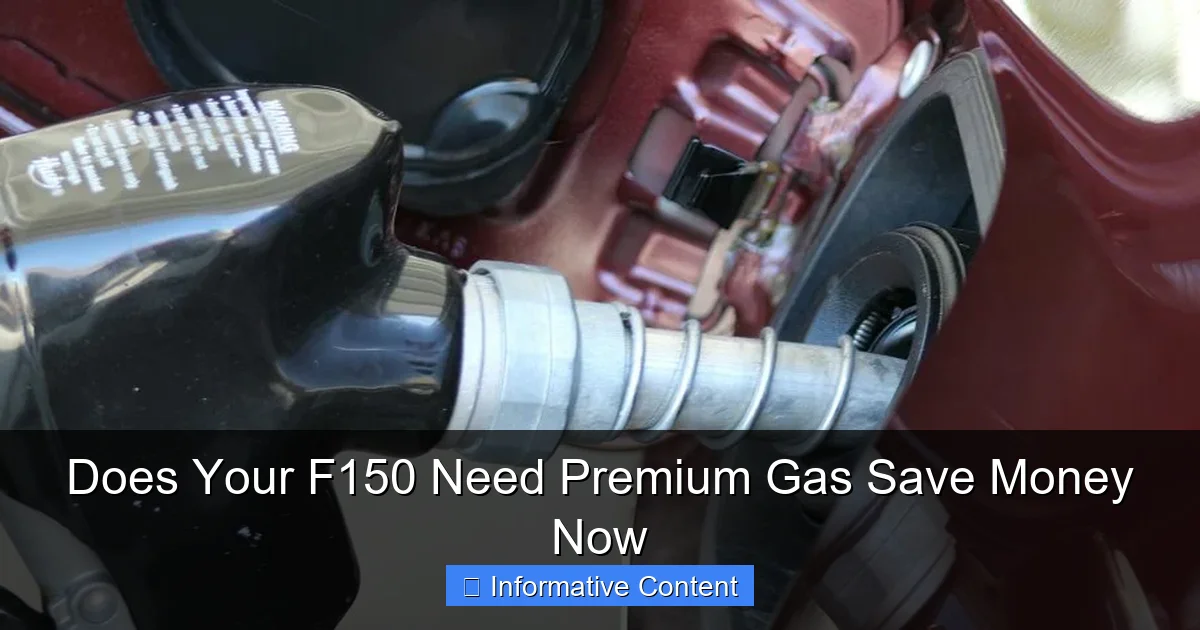
Visual guide about does f150 need premium gas
Image source: landcruiserrestorations.com
Checking Your Owner’s Manual – Your Best Guide
Seriously, grab that glove compartment manual. It’s packed with precise recommendations for your specific year and engine. You can also often find the recommended fuel type printed right inside your fuel filler door. Different F-150 engines, from the naturally aspirated V8s to the powerful EcoBoost lineup, have varying requirements and recommendations.
The EcoBoost Dilemma: Recommended vs. Required
This is where the “does F150 need premium gas” debate really heats up for many owners. Many Ford F-150s, particularly those equipped with the EcoBoost engines (like the 2.7L and 3.5L V6), often state “recommended” premium (91+ octane) for optimal performance, but “allow” regular (87 octane).
Why the recommendation? EcoBoost engines use turbochargers to force more air into the cylinders, which boosts power but also increases cylinder pressure and heat. This makes the engine more susceptible to pre-ignition or knocking. Premium fuel helps prevent this. However, modern Ford engines are incredibly smart. They have sophisticated engine control units (ECUs) that can detect knocking and automatically adjust engine timing to prevent damage when running on lower octane fuel. This means your F-150 won’t be harmed, but there might be a trade-off.
For F-150s with the 5.0L V8 engine, the recommendation is almost always 87 octane regular unleaded fuel. These engines are designed to perform optimally on regular, and premium will offer no discernible benefit.
The Real-World Impact of Using Regular Gas in an EcoBoost
So, if your EcoBoost F-150 recommends premium but allows regular, what happens when you choose 87 octane?
Performance and Efficiency Differences
When your EcoBoost F-150 runs on regular 87 octane fuel, its ECU will detect the lower knock resistance. To protect the engine, it will slightly retard the ignition timing. What does this mean for you? You might experience a slight reduction in:
- Horsepower and Torque: Your F-150 might not feel quite as punchy, especially during hard acceleration or when towing.
- Fuel Efficiency: While often minor, some owners report a slight dip in miles per gallon. The engine has to work a little harder to produce the same power, which can burn more fuel.
For daily commuting or light hauling, many drivers won’t even notice this difference. However, if you frequently push your F-150 hard, tow heavy loads, or drive in hot climates, the performance difference on premium might become more apparent.
Is Engine Damage a Concern?
Generally, no. As mentioned, modern F-150 engines are designed with adaptive ECUs. They are built to safely operate on 87 octane, even if premium is recommended for peak performance. The engine’s computer makes real-time adjustments to prevent damaging pre-ignition. So, running regular gas in an EcoBoost F-150 that recommends premium won’t typically cause engine damage or reduce its lifespan under normal driving conditions. This is a common concern when people ask, “does F150 need premium gas,” and it’s good to know the engineers have you covered.
When Might Premium Gas Be Worth It for Your F-150?
While most F-150s are perfectly fine on regular, there are specific scenarios where premium might offer a noticeable benefit for certain engines.
Max Performance and Towing
If you own an EcoBoost F-150 and regularly push it to its limits – think heavy towing, hauling maximum payload, or frequent spirited driving – using premium 91 or 93 octane fuel can unlock that engine’s full potential. The ECU won’t need to retard timing as much, allowing for maximum horsepower, torque, and responsiveness. For instance, if you’re embarking on a cross-country trip with a large RV in tow, filling up with premium might give you peace of mind and better performance on those long hauls and uphill climbs.
Hot Weather Driving
Higher ambient temperatures can increase the likelihood of engine knocking, especially in boosted engines. If you live in a very hot climate or are driving through one during summer, using premium fuel in your EcoBoost F-150 could help maintain optimal engine performance and efficiency, reducing the need for the ECU to pull back timing. This is another situation where considering “does F150 need premium gas” might lean towards “yes, for this trip.”
Testing It Out Yourself
The best way to truly know if premium makes a difference for your driving style and your F-150 is to conduct a simple experiment. Try running three or four consecutive tanks of premium fuel. Pay attention to how your F-150 feels – its responsiveness, power, and fuel economy. Then, switch back to regular for a few tanks and note any differences. You might find the difference negligible for your daily driving, or you might discover that premium truly enhances your driving experience for specific tasks.
The Cost Factor: Saving Money at the Pump
Let’s be honest, for many of us, the decision of whether an F150 needs premium gas ultimately comes down to our wallets.
Calculating the Savings
The price difference between regular and premium fuel can range from 20 cents to 80 cents or more per gallon. Let’s do a quick calculation:
- Assume a 26-gallon F-150 fuel tank.
- Assume a price difference of $0.50 per gallon between regular and premium.
- Saving per tank: 26 gallons * $0.50/gallon = $13.00.
If you fill up once a week, that’s $13 saved * 52 weeks = $676 per year! That’s a significant amount of money that could go towards other truck accessories, maintenance, or just back into your pocket. Even if your F-150 uses premium and gets slightly better MPG, say 1 MPG more, the cost savings from the cheaper regular fuel often outweigh that small efficiency gain for most drivers.
Long-Term vs. Short-Term Costs
For most F-150 owners, especially those with the V8 or EcoBoost models primarily used for daily driving and light duties, the long-term cost savings of consistently using regular 87 octane gas are substantial. You won’t be harming your engine, and you’ll be keeping more money in your bank account. Only if you consistently experience the specific scenarios outlined above (heavy towing, extreme heat, or a strong desire for maximum power) should you consider premium. For the vast majority, answering “does F150 need premium gas” will lead to a confident “no” for everyday use.
So, there you have it. The question of “does F150 need premium gas” isn’t a simple yes or no, but it’s often leaning towards “no” for most drivers and most F-150 engines. Your F-150 is a marvel of modern engineering, designed to be robust and adaptable. For the V8 models, 87 octane is exactly what it needs. For the popular EcoBoost engines, while premium is recommended for peak performance, regular 87 octane is perfectly safe and suitable for everyday driving, thanks to smart engine management systems.
Before you fill up next time, take a quick peek at your owner’s manual or fuel door. Understand your F-150’s specific needs, consider your driving habits, and then confidently choose the fuel that makes the most sense for you and your budget. Most likely, you’ll be saving a good chunk of change without sacrificing your F-150’s health or capability. Happy driving!
Frequently Asked Questions
Does my Ford F-150 truly require premium gas?
For most F-150 models, including those with popular EcoBoost engines (like the 2.7L and 3.5L), premium 91 octane gasoline is recommended for optimal performance and horsepower, but it is not strictly required. You can safely use regular 87 octane gasoline without causing damage to your engine, though you might experience a slight reduction in power and efficiency.
What type of gasoline is generally recommended for F-150 trucks?
The majority of Ford F-150 models are designed to run perfectly fine on regular 87 octane unleaded gasoline. Always check your owner’s manual or the inside of your fuel door for the manufacturer’s specific recommendation tailored to your truck’s engine.
Are there any benefits to using premium gas in my F-150, even if it’s not required?
Yes, for certain F-150 engines, particularly the EcoBoost variants, using premium 91+ octane fuel can unlock maximum horsepower and torque. The engine’s computer will adjust timing to take advantage of the higher octane, potentially leading to better acceleration and improved towing performance under heavy loads.
What happens if I use regular 87 octane gas when premium is recommended for my F-150?
If your F-150 engine recommends premium but doesn’t strictly require it, using 87 octane will not harm your engine. The engine’s computer (ECU) will detect the lower octane and automatically adjust timing to prevent engine knocking, which may result in a slight decrease in horsepower, torque, and possibly fuel economy.
Which F-150 engines specifically benefit most from premium gas?
The F-150 engines that see the most significant performance boost from premium gas are typically the 2.7L EcoBoost and 3.5L EcoBoost V6 engines. For these engines, Ford often publishes two horsepower figures: one based on 87 octane fuel and a higher one achieved with 91+ octane fuel.
Can using premium gas improve my F-150’s fuel economy?
While using premium gas might offer a marginal improvement in fuel efficiency for some F-150 EcoBoost engines by allowing the engine to operate at peak performance, the additional cost usually outweighs any savings at the pump. For most F-150s, the primary benefit of premium fuel is performance rather than significant fuel economy gains.