Never Wonder How to Find Correct Battery Group Size Again
Featured image for how to find correct battery group size
Image source: cdn-assets.colemanequip.com
Never struggle to find your vehicle’s correct battery group size again, as it’s crucial for optimal performance and safety. This essential information can be found in your owner’s manual, directly on your current battery’s label, or via readily available online lookup tools and automotive parts stores. Knowing your group size ensures a perfect physical and electrical match, preventing costly issues.
Have you ever experienced that heart-stopping moment when you turn the key, and all you get is a pathetic click or, worse, complete silence? It’s a feeling we all dread, and often, the culprit is a dead car battery. When that happens, the race is on to get a new one, but then you’re hit with a wave of questions: What kind of battery do I need? What’s a CCA? And perhaps the most perplexing, what in the world is a battery group size?
You’re not alone if you’ve felt overwhelmed by the various numbers and codes on battery labels or online product descriptions. Picking the wrong battery isn’t just an inconvenience; it can lead to fitment issues, damage to your vehicle, or simply leave you stranded again sooner than you’d like. Getting the correct battery group size is paramount for a smooth replacement and reliable performance. It’s like trying to fit a square peg in a round hole – it just won’t work, and you might break something trying.
But don’t worry! I’ve been there, staring blankly at shelves of batteries, unsure which one to choose. That’s why I’m here to guide you through the process, step-by-step, just like I would help a friend. By the end of this post, you’ll never wonder how to find the correct battery group size again. We’ll explore several foolproof methods to ensure you get exactly what your vehicle needs.
Key Takeaways
- Check Old Battery: Find the group size label directly on your existing battery.
- Consult Manual: Your vehicle’s owner’s manual provides the official group size.
- Use Online Tools: Input vehicle details on retailer websites for accurate results.
- Verify with VIN: Your VIN ensures the most precise battery fitment information.
- Measure Carefully: If labels are missing, measure length, width, and height.
- Match Terminals: Always confirm the terminal post configuration aligns with your vehicle.
📑 Table of Contents
Understanding Battery Group Sizes – More Than Just Dimensions
Let’s start with the basics. What exactly is a “battery group size”? Essentially, it’s a standardized code (like 24, 35, 65, or 34/78) that specifies the physical dimensions of the battery, including its length, width, and height. But it’s not just about how big it is; the group size also dictates the terminal type and location (e.g., top post, side post, or dual terminal) and the hold-down mechanism type.
Think of it like shoe sizes – you wouldn’t try to fit into a size 6 if you wear a size 9, right? The same logic applies here. The group size ensures the battery physically fits into your car’s battery tray, clears the hood, and allows the cables to connect properly. While cold cranking amps (CCA) and reserve capacity (RC) are crucial for power delivery, they are secondary to the physical fitment defined by the correct battery group size. You need the battery to physically fit first before considering its power output.
The Importance of Physical Fit
Why is this physical fit so critical? If a battery is too large, it simply won’t fit into the tray. If it’s too small, it might rattle around, potentially damaging the battery itself or nearby components. Incorrect terminal placement can cause cables to be too short or stretched, creating a safety hazard or preventing connection altogether. Trust me, trying to force the wrong battery in is a recipe for frustration and potential electrical problems.
Your Vehicle’s Manual – The Ultimate Source
When in doubt, always go to the source: your vehicle’s owner’s manual. This is hands down the most reliable place to find the correct battery group size for your specific car, truck, or SUV. Manufacturers provide this information because they know exactly what battery was designed to fit and perform optimally in your vehicle.
You can usually find the owner’s manual in your glove compartment. If it’s missing, don’t despair! Most vehicle manufacturers offer digital versions on their official websites, often as a downloadable PDF. Simply search for your car’s year, make, and model, plus “owner’s manual.” Once you have it, look for sections related to “Maintenance,” “Specifications,” or “Battery.” My friend Sarah, for example, found hers right on page 150 of her Honda Civic manual, clearly stating the recommended group size 51R.
Decoding the Manual’s Info
The manual will typically list not only the recommended battery group size but often also the minimum required Cold Cranking Amps (CCA) and Reserve Capacity (RC). These are important for ensuring your battery has enough power to start your engine in various conditions and run your accessories. Always strive to meet or exceed these specifications once you’ve identified the correct battery group size.
Look at Your Old Battery – If It’s Still There
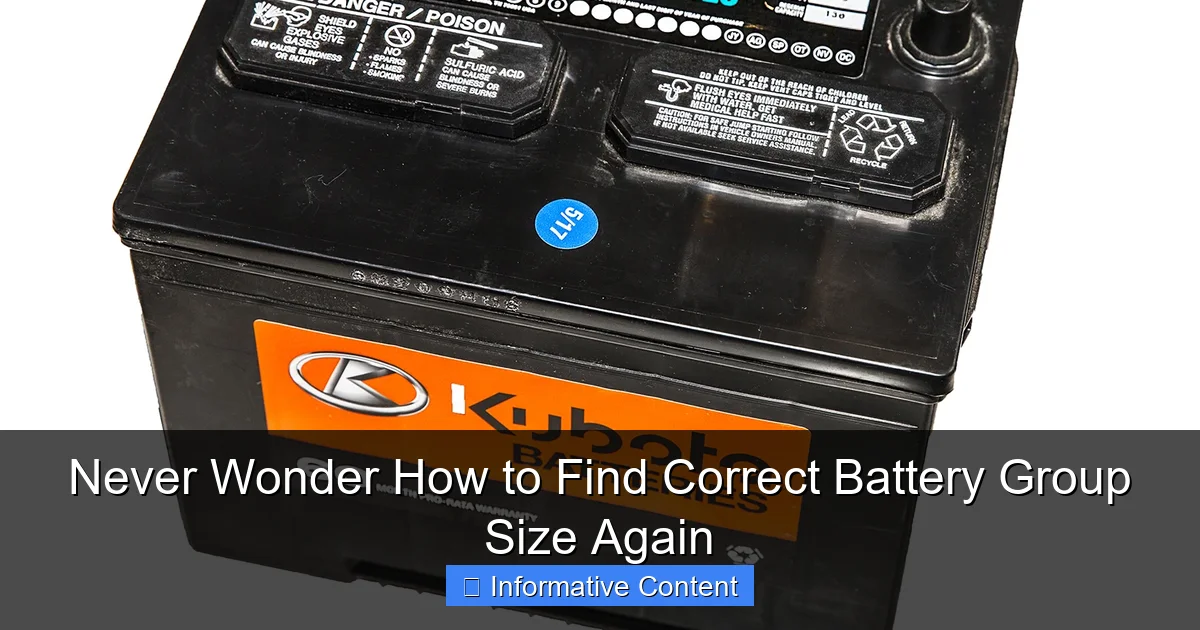
If your old battery is still in the car and accessible, this is often the quickest way to find the group size. Most batteries have their group size clearly labeled on the top or side of the case. It might be printed on a sticker, molded into the plastic, or even etched onto the battery itself.
What to Look For on the Label
You’ll typically see a number like “24,” “35,” or “65.” Sometimes, you might see dual numbers like “34/78,” which indicates a battery that can fit either group 34 or group 78 applications, usually due to having dual terminals. Before assuming this is the correct battery group size, however, exercise a bit of caution. While it’s usually a good indicator, there’s always a small chance a previous owner might have installed an incorrect battery. It’s always best to cross-reference this information with another method, like checking your owner’s manual or an online database, just to be sure.
Online Tools and Retailer Databases – Your Digital Helpers
In today’s digital age, finding the correct battery group size has never been easier, thanks to online tools. Websites for major auto parts retailers (like AutoZone, Advance Auto Parts, O’Reilly Auto Parts, Pep Boys) and battery manufacturers (like Interstate Batteries, Optima, AC Delco) all offer “Find Your Battery” tools. These are incredibly convenient and often provide a comprehensive list of compatible batteries.
How to Use These Tools
Simply navigate to the battery section of their website and input your vehicle’s year, make, model, and sometimes engine type. The tool will then present you with a list of batteries that are guaranteed to fit your vehicle, including the appropriate group size. I remember looking up a battery for my old Ford F-150 on an auto parts website; it instantly showed me all the compatible group 65 batteries, along with various CCA options. This method is particularly helpful if you don’t have your manual or can’t easily read the label on your old battery.
Beware of Multiple Options
Sometimes, these tools might show a few different battery options for your vehicle. This usually happens if your car was offered with different engine sizes (e.g., a 4-cylinder vs. a 6-cylinder) or different trim levels, which might require slightly different batteries. Always double-check that you’re selecting the option that matches your specific vehicle’s configuration to ensure you get the correct battery group size.
The Physical Measurement Method – When All Else Fails
If you’ve exhausted the previous methods – maybe your manual is gone, the old battery is unreadable or missing, and online tools aren’t quite clear – you can always resort to physical measurement. This is a bit more involved but ensures accuracy.
Measuring Tips for Accuracy
- Measure the Battery Tray: Use a tape measure to get the exact length, width, and height of the space where the battery sits. This is crucial because it tells you the maximum dimensions your new battery can have.
- Check Terminal Location: Note whether your vehicle uses top posts, side posts, or both. Also, observe which side the positive and negative terminals are located on relative to the battery’s overall orientation in the tray. This prevents issues with cable reach.
- Consider Hold-Downs: Look at how your current battery (or the tray) is secured. Some hold-downs clamp down on the top, while others secure the battery from the bottom ledge.
Once you have these measurements and details, you can compare them to a standard battery group size chart (easily found with a quick online search for “battery group size chart dimensions”). This will help you identify the correct battery group size that physically matches your vehicle’s requirements.
When in Doubt, Ask a Professional
My final piece of advice, and perhaps the most important: if you’re ever unsure after trying these methods, don’t guess! Head to your local auto parts store or a trusted mechanic. These professionals have specialized databases and years of experience that allow them to quickly and accurately determine the correct battery group size for virtually any vehicle.
They can also advise you on other important factors like the appropriate CCA for your climate and driving habits. There’s no shame in asking for help; it’s always better to get professional advice than to buy the wrong battery and face more headaches down the road.
Finding the correct battery group size doesn’t have to be a daunting task. By utilizing your owner’s manual, inspecting your old battery, leveraging online tools, or even taking precise measurements, you can confidently choose the right power source for your vehicle. Remember, a properly fitting battery is essential not just for starting your car, but also for its overall health and safety.
So, the next time your car battery gives up the ghost, you’ll be armed with the knowledge and confidence to make the right choice. No more guessing, no more second-guessing – just the satisfaction of knowing you’ve found the perfect fit. Happy driving!
Frequently Asked Questions
What is battery group size and why is it important to find the correct one?
Battery group size refers to the standardized dimensions (length, width, height) of a battery, along with its terminal type and location. Finding the correct battery group size is crucial to ensure the battery physically fits securely into your vehicle’s battery tray and that the terminals align properly with your vehicle’s cables, preventing installation issues and potential damage.
How do I find the correct battery group size for my vehicle?
The easiest way to find the correct battery group size is to check your vehicle’s owner’s manual, which usually lists the recommended battery specifications. Alternatively, you can look for a label on your existing battery; the group size is typically printed on top or the side.
My existing battery doesn’t have the group size clearly marked. What should I do?
If your old battery’s group size isn’t visible, you can use online fitment guides provided by battery manufacturers or auto parts stores. These tools allow you to input your vehicle’s year, make, and model to find the recommended battery group size. You can also physically measure your battery tray and compare it to group size dimension charts online.
Can I use a different battery group size if the exact one isn’t available?
While it’s generally recommended to stick to the exact battery group size, sometimes a “cross-fit” or “equivalent” size might work if it has similar dimensions and terminal placement. However, using an incorrect size can lead to improper fitment, cable strain, or even short circuits, so always prioritize the recommended size for safety and optimal performance.
Where is the battery group size usually printed on the battery itself?
The battery group size is typically printed on a label directly on the top or side of the battery casing. It will often appear as a number followed by a letter, such as “35,” “24F,” or “H6/48.” Look for these specific markings to identify your current battery’s group size quickly.
Are there online tools or resources to help me find the correct battery group size for my car?
Yes, most major battery retailers and automotive parts websites offer online “battery finder” tools. You simply enter your vehicle’s year, make, and model, and the tool will display the recommended battery group size along with compatible options. Your vehicle manufacturer’s website or an owner’s manual lookup can also provide this information.